Showing posts with label there is no longer jew or greek. Show all posts

Wednesday, August 18, 2010

"There, where they burn books, they will in the end burn people."

When I returned to my house in Durham a few days ago, I found one minor but interesting change had been made to my room by our summer sub-letters. I have two small posters of Islamic calligraphy that I got when I took an Islamic Civilization class in undergrad. I had left them on the wall since they were attached with adhesive, and when I got back, they had been moved from the wall to the outside of the door to my room. I am in no way upset by this--I told the guys sub-letting to feel free to move things from the wall, I just left most of it up for simplicity's sake on my end. But since my large poster of Picasso's "The Old Guitarist," several framed photos from my travels, and a few other decorations stayed up, I know that the removal of the calligraphy was intentional and pointed.

Now that's fine. The funny thing is, neither of the texts represented in those calligraphy works is explicitly Muslim. They're in the Ottoman style (I believe at least one of them is in Turkish), and one translates, "O Lord, refine me!" while the other says simply, "Be!", a reference to God's act of speaking the world into being. No Shahada (which I think is depicted in this image, actually) or anything like that.

Already musing over that event, I came across this article in the News & Observer, written by Richard Hays, my adviser and the new dean of the Divinity School. The title is "WWJD? Not burn the Quran," and it is an editorial in response to the planned Quran burning sponsored by Dove World Outreach Center (a, um, "New Testament church" in Gainesville, Florida). You can learn more on their Facebook page, entitled "International Burn a Koran Day."

I posted the link on Facebook and watched in amusement as myself and my friends spawned a 44-comment (at last count) debate of sorts over Quran burning, the Islamic cultural center being built near Ground Zero, Islamic law, etc. The thing is, I could tell that people were just talking on different planes. People opposed to the building of the mosque (and even one or two who support burning Qurans) simply weren't talking about the same things as people on the other side.

The funny thing is, I'm not sure the people opposed to the building of the mosque even read Hays' article. He talks about a Holocaust memorial in Germany with a plaque that reads, "There, where they burn books, they will in the end burn people." Even if a person isn't directly supportive of International Burn a Koran Day, the ignorance and malice that is a part of that whole attitude is extremely dangerous.

And that's the thing--most non-Muslims don't know a thing about Islam. I only have what little I gleaned from an admittedly easy Islamic Civ class, but the way people talk about the Quran and Sharia law makes it clear they have no idea what they're talking about. The Quran and the Bible have a number of parallel passages (though I suppose the Dove World Outreach Center wouldn't care, since those are mainly from the Old Testament) and Sharia law breeds extremism only in the same way reading the Bible results in intolerant fundamentalism.

Chief Rabbi Jonathan Sacks wrote a book I really love called The Dignity of Difference. [Sidebar: Chief Rabbi = Archbishop of Canterbury for Jews. And, um, Archbishop of Canterbury = Pope for Anglicans. Roughly.] In it he says, "Covenant tells me that my faith is a form of relationship with God--and that one relationship does not exclude others." He cites Isaiah 19: "The Egyptians and Assyrians will worship together. In that day Israel will be third, along with Egypt and Assyria, a blessing on earth. The Lord Almighty will bless them, saying, 'Blessed be Egypt my people, Assyria my handiwork, and Israel my inheritance.'" Those words are shocking even if they don't translate directly to modern sensibilities.

Now, I'm not saying that all paths lead to God. Although, to quote the popular Christian novel The Shack: (Jesus responding to the question of whether all roads lead to him) "Not at all...most roads don't lead anywhere. What it does mean is that I will travel any road to find you." Faith is not about claiming to have a corner on truth over against everyone else. It is a gift to be shared, not a possession to be defended. Our witness should be a loving overflow of the joy we find in our faith, not an attack using it as a weapon.

I could say more about that and probably will later, but for now, I'm gonna say (to my readers and to myself): examine yourselves for bigotry, which isn't just about race, it's about a stubborn adherence to your own views and intolerance of all others (see Wikipedia). Now, being open to other views and beliefs does not mean accepting them in lieu of your own, so I'm not telling you to believe in Allah. But especially among the Abrahamic faiths, there is so much we can learn from each other that we just lose when we equate Muslims with terrorists and live in a self-imposed culture of fear and suspicion.

And now, I end this post with some humor. Here's a segment from The Daily Show on the mosque controversy.


The Daily Show With Jon StewartMon - Thurs 11p / 10c
Municipal Land-Use Hearing Update
www.thedailyshow.com
Daily Show Full EpisodesPolitical HumorTea Party

Friday, July 9, 2010

The Kind of Person Who Would Date a Black Guy

Recently, I was catching up on life with an old friend, and as usual our conversation turned to dating. She gave me the 411 on her romantic life, then asked me about my going-on-17-months relationship with my boyfriend, Gary. I told her about music, church and his recent trip to El Salvador, and then she said something that I found amusing. "When I saw you were dating Gary, I was shocked," she said. "I just never thought you were the kind of person who would date a black guy."

Now I'm paraphrasing, and also let me give you some background: we were at a gathering of a bunch of her friends, several of whom are black. She didn't intend that as a derogatory comment at all. But it made me chuckle, and I recalled that there are actually several people in my life who have said things like "I always knew you'd end up with a black guy." Heck, I've said that myself.

But what does that mean? What are we saying when we refer to the kind of person who would date a black guy? Let me just give you a few images of that "kind of person":

That's Heidi Klum, supermodel and actress, on the left; her husband is English singer Seal. And on the right is Idina Menzel, the original Elphaba in the Broadway musical Wicked, and more recently Lea Michele/Rachel Berry's mother Shelby in the Fox television series Glee; her husband is Taye Diggs, whom she met when they were both in the original Broadway cast of Rent.

And for that matter...

On the left is Jada Pinkett Smith, actress/producer/director/singer, and wife of the ubiquitous Will Smith. And on the right--do I really have to do this?--first lady Michelle Obama, Princeton University and Harvard Law graduate and husband to Barack Obama (yeah, yeah, he's only half black--Gary's 1/8 Cherokee).

(Side note: I had to laugh at myself--I named these images "heididina.jpg" and "jadabama.jpg" on my laptop.)

I talked to my dad about this the other day--he had overheard a conversation the other day where a white man was talking about someone and mentioned that "she's got herself a black boyfriend." It's interesting that we find that kind of thing worth pointing out. Sure, it's not the norm--but it's funny how we can be pointing out people in a room and say, "the guy in the red shirt is Bob, the girl in the blue shirt is Susie, and the black guy is Rob." That's not necessarily wrong--I mean, if there's one black guy in the room, it's easiest to point him out by referring to his skin color. If I'm the only white girl around (which happens to me pretty regularly), I have no problem being "the white girl."

A few months ago, a friend of mine (who is white) told Gary and I about a frustrating experience he'd had at work. He was interviewing for a job and felt like it went really well. Later, however, his superiors told him they were concerned because he had said a few things that people might find racist. Here they are: first, my friend (who is also a musician) had been talking about a guy he knows who's a brilliant piano player, and he mentioned that he plays at a black church. Second, he referred to a client he'd been dealing with recently on the phone; her name was "Rosa," and my friend had no idea what ethnicity she was, but since she pronounced her name by rolling the "r," he did the same. His superiors felt like the reference to "a black church" was racist, and that he was mocking Rosa by pronouncing her name the way it's meant to be pronounced.

I had to laugh at that. I'm sure that in professional situations you have to be particularly sensitive to such things, but I had to think, I feel like only white people who don't really know any non-white people would say something like that is racist. "Am I racist if I say I have a black boyfriend?" I asked. True, if I'm around black people I don't know, I'll use the term "African-American" if I have occasion to refer to race--but my dad pointed out that not all black people are African-American. What about Haitians? And there's a difference between Africans and African-Americans, both ethnically and culturally, even within the U.S.

Anyway, this is just me throwing stuff out there to think about. Do you have to be a certain kind of person to date outside your racial/ethnic background? If so, what does that even mean? If we all are made in the image of God, what does that mean for how we understand race?

Thursday, May 6, 2010

"You shall love the alien as yourself"

This morning, I saw this posted as a friend's Facebook status:

"JUST SO I UNDERSTAND THIS...YOU PASS THE NORTH KOREAN BORDER ILLEGALLY YOU GET 12 YRS HARD LABOR, YOU PASS THE AFGHAN BORDER ILLEGALLY YOU GET SHOT. YOU PASS THE AMERICAN BORDER ILLEGALLY YOU GET A JOB, DRIVER'S LICENSE, ALLOWANCE FOR A PLACE TO LIVE, HEALTH CARE, EDUCATION, BILLIONS OF DOLLARS SPENT SO YOU CAN READ A DOCUMENT. WE CARRY PASSPORTS IN OTHER COUNTRIES OR FACE JAIL TIME. REPOST IF YOU AGREE"

My only direct response to this is...so our standards of comparison are North Korea and Afghanistan now? And getting shot in Afghanistan happens a lot more often for a lot more reasons than crossing the border illegally...

My indirect response comes from the fact that when I saw this, I had just read the daily office from the BCP with my housemates. The Old Testament lesson for today is this:

"When an alien resides with you in your land, you shall not oppress the alien. The alien who resides with you shall be to you as the citizen among you; you shall love the alien as yourself, for you were aliens in the land of Egypt: I am the Lord your God."
-- Leviticus 19:33-34


I was so grateful for this. I don't really know how to respond to all the nastiness I see getting slung around online over Arizona and immigration and whatnot, and it turns out I don't have to say a thing. I can just point to these verses. Because, interestingly enough, most of the people I know who are rabidly anti-immigration are...Christians. I'm not demonizing those people--I have many friends and relatives who fall into that category. I'm just saying.

I wasn't going to blog about the issue at all, but this news item pushed me over the edge.

Sunday, December 21, 2008

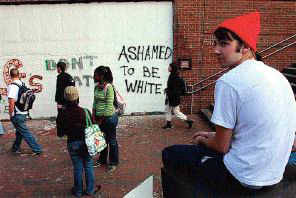
Ashamed to Be White

I’ve known for a while that racial reconciliation was going to be a particular focus of my ministry and vocation. Lately, I’ve embraced that with full force, especially in my choices for reading material—I’ve read Stokely Carmichael’s Black Power and The Autobiography of Malcolm X, and I’m almost done with James H. Cone’s Black Theology and Black Power.

People don’t understand my interest in and stance on race issues (I’m white, by the way). They tell me that it’s the 21st century, that the 1960s were a long time ago. They tell me race isn’t as much of an issue anymore. When Obama was elected, I wanted to talk about the significance of his racial background but was told by several people that it didn’t matter that he was black. True, his ethnicity has nothing to do with how well he’ll lead the country, but I couldn’t help but notice that everyone who said this to me was white. My black friends knew it mattered that they had a black president.

You can tell me that race isn’t an issue, even that Obama’s victory ushered in a new era in race relations, but I won’t believe you. After the election, students at N.C. State wrote graffiti on a wall on campus with such hateful messages as “Hang Obama by a noose” and “Shoot that n----- in the head.” And this at a respected institution of higher learning. What were you saying about race not being an issue anymore?

Now it’s time to relate all of this to Christianity. What is the Church supposed to do about the lingering racism that festers in our nation? One student’s response to the graffiti at NSCU offered a partial answer: when the wall had been whitewashed, he wrote, “Ashamed to be white.” Malcolm X and Carmichael both believed that whites admitting the sin of racism was the first step to the emancipation of blacks—and, as Cone would add, the emancipation of whites, for “the man who enslaves another enslaves himself.” Most churches confess corporate sin on at least a weekly basis. How do we confess the inherited sin of racism?

One answer comes from Malcolm Boyd in his book Are You Running With Me, Jesus? “During a Freedom Ride in the Deep South in 1961, one of my fellow Episcopalian priests said: ‘It seems to me this is really a kind of prayer—a kind of corporate confession of sin.’” This aligns with James H. Cone’s insistence that Christ’s very being is tied up with his identification with the oppressed peoples of the world—and that the Church must enter into a radical identification with that oppressed Christ and our neighbors with whom he shares his person.

The first step towards reconciliation is confession. The off-Broadway hit Avenue Q, although crass at times (or half the time) makes a good point in its song “Everyone’s a Little Bit Racist.” If we insist that race is not an issue, we only prop up old systems of injustice. The Church must help confront Americans with the sin of racism. And the Church must provide a model for radical identification with the oppressed. To do otherwise is to deny Christ.

Monday, May 26, 2008

Sorry, Blame It On Me

This past weekend, I attended the United Methodist Student Movement's 2008 Student Forum at American University in Washington, D.C. Focusing on the theme "Be The Change," we spent the weekend in worship, fellowship, and learning about the legislative process in the United Methodist Church and the issues facing church and society today.

This issue of racism and the church's response came up frequently. On Friday, there were a variety of immersion trips into D.C. My group focused on gentrification and toured the historical Shaw neighborhood, the location of the 1968 race riots and, of course, Ben's Chili Bowl. Other groups learned about civil rights, women's rights, racism of mascots and so on. We were blessed to have present at Forum representatives from the Oklahoma Indian Missionary Conference; we heard from a number of people regarding the church's responsibility to honor the indigenous people of this country and participated in a letter-writing campaign urging the Washington Redskins to change the name of their mascot.

One thing that struck me in particular was beautifully framed in a sermon delivered by Jennifer Battiest of the Oklahoma Indian Missionary Conference. Jennifer described some of the injustices that persist in this world and reflected on the ways in which the church often refuses to shoulder responsibility for past crimes. She cited R&B singer Akon, whose song "Sorry, Blame It On Me" begins with an apology for his own misdeeds but then goes on to apologize for things he did not do but for which the guilty party refuses to take blame. Jennifer reminded us of another person who long ago took blame that wasn't his. She asked us why we can't use that as a model for righting wrongs that perhaps we did not take a part in personally but, because we are the body of Christ, for which we are collectively responsible.

Later, I was having a conversation with a group of students attending Forum, and one of them, a young white man, told us that he was tired of being preached at. Why, he asked, should he be made to feel guilty for things he didn't do? I reacted very strongly to his question in part because, just days before the conference, I had read Toni Morrison's novel The Bluest Eye. In this heartbreaking but compelling story, Morrison tells about a young black girl, Pecola Breedlove, who prays every day for the blue eyes that are so beautiful on the white baby dolls she had seen all her life. This summer, I will be working at Asbury Temple UMC in Durham, North Carolina, a predominantly African-American congregation. I will spend a great deal of my time working with the children of the surrounding community. I am white, and I have blonde hair and green eyes. I somehow must become a role model for these children while affirming them in their own identity. As long as little black girls are told that their dark skin and eyes don't match the standard of beauty in this country, I will be accountable for that sin and for combating that and many other injustices perpetrated by history and by our media.

The important thing in situations where the church or some sector of the church is guilty of injustice is not that those of us who are privileged guilt-trip ourselves into oblivion. However, as long as individuals and groups are marginalized and oppressed, even because of sins committed hundreds, even thousands of years ago, the church must be brave enough and compassionate enough to take responsibility and action. Paul notes that being part of the body of Christ means that "If one member suffers, all suffer together with it" (1 Corinthians 12:26). If even a single member of the body of Christ is oppressed, we are all oppressed. None of us can be whole until all are honored and loved. Practically speaking, this is not easy, because as much as this is a communal effort, it takes individuals who are willing to take the blame and be the change.

Saturday, February 23, 2008

We're All Just People, Aren't We?

This morning, I went and helped out at the food ministry my church does the second and fourth Saturday of each month. I'd never been before, and it terrified me at first. I was the only white person, and it's hard even to pretend to blend in when you have long, blonde hair and the complexion of a Swede. I walked in, talked to a few people, and then bolted. I got back in my car, turned the engine on, and got ready to drive away. I'd come back another time, I thought. But then I took a deep breath and made myself go back inside.

Julius, another member of Asbury Temple, took me on, explaining to me how the food ministry works and taking me through the line to show what kinds of food people can pick up. He was adamant about their insistence on getting fresh produce from the food bank and not just canned goods and snacks.

I was then turned over to the ladies working the table, handing numbers to people as they walked in, calling them up and taking information from newcomers. One man waiting in line saw me smile and called out, "Hey, what's up dimples?" Later that same man was asking me a question, to which I didn't know the answer, and when I apologized for being unhelpful, he just smiled and said, "You'll fit in. You'll get it. I mean, we're all just people, aren't we?"

I watched a woman named Valencia as she handed out numbers and kept track of where we were on the list. From talking to her, I learned that she had started coming to the food ministry when she lost her job, and that she tries to help out sometimes. She's been coming to church at Asbury Temple lately. She just got a new job that starts Monday, so she won't be needing to come back for food. However, she promised she'd come out to volunteer.

When I told him all this, my boyfriend remarked that it's really neat that Asbury Temple can be functional for people like Valencia even though it has become something of a novelty for Duke Divinity students. I think ATUMC has something really good going on, which is why I love it so much. I can acknowledge the white guilt that sometimes compels me in those settings, but I'd be foolish to deny it, and I do feel called to that place, to that community. I'll keep going back to the food ministry and I'll learn even more if I work there over the summer. Maybe, if I'm around long enough, I'll start to learn the names of people who come through every other Saturday. That's a start, isn't it?
Showing posts with label there is no longer jew or greek. Show all posts

Wednesday, August 18, 2010

"There, where they burn books, they will in the end burn people."

When I returned to my house in Durham a few days ago, I found one minor but interesting change had been made to my room by our summer sub-letters. I have two small posters of Islamic calligraphy that I got when I took an Islamic Civilization class in undergrad. I had left them on the wall since they were attached with adhesive, and when I got back, they had been moved from the wall to the outside of the door to my room. I am in no way upset by this--I told the guys sub-letting to feel free to move things from the wall, I just left most of it up for simplicity's sake on my end. But since my large poster of Picasso's "The Old Guitarist," several framed photos from my travels, and a few other decorations stayed up, I know that the removal of the calligraphy was intentional and pointed.

Now that's fine. The funny thing is, neither of the texts represented in those calligraphy works is explicitly Muslim. They're in the Ottoman style (I believe at least one of them is in Turkish), and one translates, "O Lord, refine me!" while the other says simply, "Be!", a reference to God's act of speaking the world into being. No Shahada (which I think is depicted in this image, actually) or anything like that.

Already musing over that event, I came across this article in the News & Observer, written by Richard Hays, my adviser and the new dean of the Divinity School. The title is "WWJD? Not burn the Quran," and it is an editorial in response to the planned Quran burning sponsored by Dove World Outreach Center (a, um, "New Testament church" in Gainesville, Florida). You can learn more on their Facebook page, entitled "International Burn a Koran Day."

I posted the link on Facebook and watched in amusement as myself and my friends spawned a 44-comment (at last count) debate of sorts over Quran burning, the Islamic cultural center being built near Ground Zero, Islamic law, etc. The thing is, I could tell that people were just talking on different planes. People opposed to the building of the mosque (and even one or two who support burning Qurans) simply weren't talking about the same things as people on the other side.

The funny thing is, I'm not sure the people opposed to the building of the mosque even read Hays' article. He talks about a Holocaust memorial in Germany with a plaque that reads, "There, where they burn books, they will in the end burn people." Even if a person isn't directly supportive of International Burn a Koran Day, the ignorance and malice that is a part of that whole attitude is extremely dangerous.

And that's the thing--most non-Muslims don't know a thing about Islam. I only have what little I gleaned from an admittedly easy Islamic Civ class, but the way people talk about the Quran and Sharia law makes it clear they have no idea what they're talking about. The Quran and the Bible have a number of parallel passages (though I suppose the Dove World Outreach Center wouldn't care, since those are mainly from the Old Testament) and Sharia law breeds extremism only in the same way reading the Bible results in intolerant fundamentalism.

Chief Rabbi Jonathan Sacks wrote a book I really love called The Dignity of Difference. [Sidebar: Chief Rabbi = Archbishop of Canterbury for Jews. And, um, Archbishop of Canterbury = Pope for Anglicans. Roughly.] In it he says, "Covenant tells me that my faith is a form of relationship with God--and that one relationship does not exclude others." He cites Isaiah 19: "The Egyptians and Assyrians will worship together. In that day Israel will be third, along with Egypt and Assyria, a blessing on earth. The Lord Almighty will bless them, saying, 'Blessed be Egypt my people, Assyria my handiwork, and Israel my inheritance.'" Those words are shocking even if they don't translate directly to modern sensibilities.

Now, I'm not saying that all paths lead to God. Although, to quote the popular Christian novel The Shack: (Jesus responding to the question of whether all roads lead to him) "Not at all...most roads don't lead anywhere. What it does mean is that I will travel any road to find you." Faith is not about claiming to have a corner on truth over against everyone else. It is a gift to be shared, not a possession to be defended. Our witness should be a loving overflow of the joy we find in our faith, not an attack using it as a weapon.

I could say more about that and probably will later, but for now, I'm gonna say (to my readers and to myself): examine yourselves for bigotry, which isn't just about race, it's about a stubborn adherence to your own views and intolerance of all others (see Wikipedia). Now, being open to other views and beliefs does not mean accepting them in lieu of your own, so I'm not telling you to believe in Allah. But especially among the Abrahamic faiths, there is so much we can learn from each other that we just lose when we equate Muslims with terrorists and live in a self-imposed culture of fear and suspicion.

And now, I end this post with some humor. Here's a segment from The Daily Show on the mosque controversy.


The Daily Show With Jon StewartMon - Thurs 11p / 10c
Municipal Land-Use Hearing Update
www.thedailyshow.com
Daily Show Full EpisodesPolitical HumorTea Party

Friday, July 9, 2010

The Kind of Person Who Would Date a Black Guy

Recently, I was catching up on life with an old friend, and as usual our conversation turned to dating. She gave me the 411 on her romantic life, then asked me about my going-on-17-months relationship with my boyfriend, Gary. I told her about music, church and his recent trip to El Salvador, and then she said something that I found amusing. "When I saw you were dating Gary, I was shocked," she said. "I just never thought you were the kind of person who would date a black guy."

Now I'm paraphrasing, and also let me give you some background: we were at a gathering of a bunch of her friends, several of whom are black. She didn't intend that as a derogatory comment at all. But it made me chuckle, and I recalled that there are actually several people in my life who have said things like "I always knew you'd end up with a black guy." Heck, I've said that myself.

But what does that mean? What are we saying when we refer to the kind of person who would date a black guy? Let me just give you a few images of that "kind of person":

That's Heidi Klum, supermodel and actress, on the left; her husband is English singer Seal. And on the right is Idina Menzel, the original Elphaba in the Broadway musical Wicked, and more recently Lea Michele/Rachel Berry's mother Shelby in the Fox television series Glee; her husband is Taye Diggs, whom she met when they were both in the original Broadway cast of Rent.

And for that matter...

On the left is Jada Pinkett Smith, actress/producer/director/singer, and wife of the ubiquitous Will Smith. And on the right--do I really have to do this?--first lady Michelle Obama, Princeton University and Harvard Law graduate and husband to Barack Obama (yeah, yeah, he's only half black--Gary's 1/8 Cherokee).

(Side note: I had to laugh at myself--I named these images "heididina.jpg" and "jadabama.jpg" on my laptop.)

I talked to my dad about this the other day--he had overheard a conversation the other day where a white man was talking about someone and mentioned that "she's got herself a black boyfriend." It's interesting that we find that kind of thing worth pointing out. Sure, it's not the norm--but it's funny how we can be pointing out people in a room and say, "the guy in the red shirt is Bob, the girl in the blue shirt is Susie, and the black guy is Rob." That's not necessarily wrong--I mean, if there's one black guy in the room, it's easiest to point him out by referring to his skin color. If I'm the only white girl around (which happens to me pretty regularly), I have no problem being "the white girl."

A few months ago, a friend of mine (who is white) told Gary and I about a frustrating experience he'd had at work. He was interviewing for a job and felt like it went really well. Later, however, his superiors told him they were concerned because he had said a few things that people might find racist. Here they are: first, my friend (who is also a musician) had been talking about a guy he knows who's a brilliant piano player, and he mentioned that he plays at a black church. Second, he referred to a client he'd been dealing with recently on the phone; her name was "Rosa," and my friend had no idea what ethnicity she was, but since she pronounced her name by rolling the "r," he did the same. His superiors felt like the reference to "a black church" was racist, and that he was mocking Rosa by pronouncing her name the way it's meant to be pronounced.

I had to laugh at that. I'm sure that in professional situations you have to be particularly sensitive to such things, but I had to think, I feel like only white people who don't really know any non-white people would say something like that is racist. "Am I racist if I say I have a black boyfriend?" I asked. True, if I'm around black people I don't know, I'll use the term "African-American" if I have occasion to refer to race--but my dad pointed out that not all black people are African-American. What about Haitians? And there's a difference between Africans and African-Americans, both ethnically and culturally, even within the U.S.

Anyway, this is just me throwing stuff out there to think about. Do you have to be a certain kind of person to date outside your racial/ethnic background? If so, what does that even mean? If we all are made in the image of God, what does that mean for how we understand race?

Thursday, May 6, 2010

"You shall love the alien as yourself"

This morning, I saw this posted as a friend's Facebook status:

"JUST SO I UNDERSTAND THIS...YOU PASS THE NORTH KOREAN BORDER ILLEGALLY YOU GET 12 YRS HARD LABOR, YOU PASS THE AFGHAN BORDER ILLEGALLY YOU GET SHOT. YOU PASS THE AMERICAN BORDER ILLEGALLY YOU GET A JOB, DRIVER'S LICENSE, ALLOWANCE FOR A PLACE TO LIVE, HEALTH CARE, EDUCATION, BILLIONS OF DOLLARS SPENT SO YOU CAN READ A DOCUMENT. WE CARRY PASSPORTS IN OTHER COUNTRIES OR FACE JAIL TIME. REPOST IF YOU AGREE"

My only direct response to this is...so our standards of comparison are North Korea and Afghanistan now? And getting shot in Afghanistan happens a lot more often for a lot more reasons than crossing the border illegally...

My indirect response comes from the fact that when I saw this, I had just read the daily office from the BCP with my housemates. The Old Testament lesson for today is this:

"When an alien resides with you in your land, you shall not oppress the alien. The alien who resides with you shall be to you as the citizen among you; you shall love the alien as yourself, for you were aliens in the land of Egypt: I am the Lord your God."
-- Leviticus 19:33-34


I was so grateful for this. I don't really know how to respond to all the nastiness I see getting slung around online over Arizona and immigration and whatnot, and it turns out I don't have to say a thing. I can just point to these verses. Because, interestingly enough, most of the people I know who are rabidly anti-immigration are...Christians. I'm not demonizing those people--I have many friends and relatives who fall into that category. I'm just saying.

I wasn't going to blog about the issue at all, but this news item pushed me over the edge.

Sunday, December 21, 2008

Ashamed to Be White

I’ve known for a while that racial reconciliation was going to be a particular focus of my ministry and vocation. Lately, I’ve embraced that with full force, especially in my choices for reading material—I’ve read Stokely Carmichael’s Black Power and The Autobiography of Malcolm X, and I’m almost done with James H. Cone’s Black Theology and Black Power.

People don’t understand my interest in and stance on race issues (I’m white, by the way). They tell me that it’s the 21st century, that the 1960s were a long time ago. They tell me race isn’t as much of an issue anymore. When Obama was elected, I wanted to talk about the significance of his racial background but was told by several people that it didn’t matter that he was black. True, his ethnicity has nothing to do with how well he’ll lead the country, but I couldn’t help but notice that everyone who said this to me was white. My black friends knew it mattered that they had a black president.

You can tell me that race isn’t an issue, even that Obama’s victory ushered in a new era in race relations, but I won’t believe you. After the election, students at N.C. State wrote graffiti on a wall on campus with such hateful messages as “Hang Obama by a noose” and “Shoot that n----- in the head.” And this at a respected institution of higher learning. What were you saying about race not being an issue anymore?

Now it’s time to relate all of this to Christianity. What is the Church supposed to do about the lingering racism that festers in our nation? One student’s response to the graffiti at NSCU offered a partial answer: when the wall had been whitewashed, he wrote, “Ashamed to be white.” Malcolm X and Carmichael both believed that whites admitting the sin of racism was the first step to the emancipation of blacks—and, as Cone would add, the emancipation of whites, for “the man who enslaves another enslaves himself.” Most churches confess corporate sin on at least a weekly basis. How do we confess the inherited sin of racism?

One answer comes from Malcolm Boyd in his book Are You Running With Me, Jesus? “During a Freedom Ride in the Deep South in 1961, one of my fellow Episcopalian priests said: ‘It seems to me this is really a kind of prayer—a kind of corporate confession of sin.’” This aligns with James H. Cone’s insistence that Christ’s very being is tied up with his identification with the oppressed peoples of the world—and that the Church must enter into a radical identification with that oppressed Christ and our neighbors with whom he shares his person.

The first step towards reconciliation is confession. The off-Broadway hit Avenue Q, although crass at times (or half the time) makes a good point in its song “Everyone’s a Little Bit Racist.” If we insist that race is not an issue, we only prop up old systems of injustice. The Church must help confront Americans with the sin of racism. And the Church must provide a model for radical identification with the oppressed. To do otherwise is to deny Christ.

Monday, May 26, 2008

Sorry, Blame It On Me

This past weekend, I attended the United Methodist Student Movement's 2008 Student Forum at American University in Washington, D.C. Focusing on the theme "Be The Change," we spent the weekend in worship, fellowship, and learning about the legislative process in the United Methodist Church and the issues facing church and society today.

This issue of racism and the church's response came up frequently. On Friday, there were a variety of immersion trips into D.C. My group focused on gentrification and toured the historical Shaw neighborhood, the location of the 1968 race riots and, of course, Ben's Chili Bowl. Other groups learned about civil rights, women's rights, racism of mascots and so on. We were blessed to have present at Forum representatives from the Oklahoma Indian Missionary Conference; we heard from a number of people regarding the church's responsibility to honor the indigenous people of this country and participated in a letter-writing campaign urging the Washington Redskins to change the name of their mascot.

One thing that struck me in particular was beautifully framed in a sermon delivered by Jennifer Battiest of the Oklahoma Indian Missionary Conference. Jennifer described some of the injustices that persist in this world and reflected on the ways in which the church often refuses to shoulder responsibility for past crimes. She cited R&B singer Akon, whose song "Sorry, Blame It On Me" begins with an apology for his own misdeeds but then goes on to apologize for things he did not do but for which the guilty party refuses to take blame. Jennifer reminded us of another person who long ago took blame that wasn't his. She asked us why we can't use that as a model for righting wrongs that perhaps we did not take a part in personally but, because we are the body of Christ, for which we are collectively responsible.

Later, I was having a conversation with a group of students attending Forum, and one of them, a young white man, told us that he was tired of being preached at. Why, he asked, should he be made to feel guilty for things he didn't do? I reacted very strongly to his question in part because, just days before the conference, I had read Toni Morrison's novel The Bluest Eye. In this heartbreaking but compelling story, Morrison tells about a young black girl, Pecola Breedlove, who prays every day for the blue eyes that are so beautiful on the white baby dolls she had seen all her life. This summer, I will be working at Asbury Temple UMC in Durham, North Carolina, a predominantly African-American congregation. I will spend a great deal of my time working with the children of the surrounding community. I am white, and I have blonde hair and green eyes. I somehow must become a role model for these children while affirming them in their own identity. As long as little black girls are told that their dark skin and eyes don't match the standard of beauty in this country, I will be accountable for that sin and for combating that and many other injustices perpetrated by history and by our media.

The important thing in situations where the church or some sector of the church is guilty of injustice is not that those of us who are privileged guilt-trip ourselves into oblivion. However, as long as individuals and groups are marginalized and oppressed, even because of sins committed hundreds, even thousands of years ago, the church must be brave enough and compassionate enough to take responsibility and action. Paul notes that being part of the body of Christ means that "If one member suffers, all suffer together with it" (1 Corinthians 12:26). If even a single member of the body of Christ is oppressed, we are all oppressed. None of us can be whole until all are honored and loved. Practically speaking, this is not easy, because as much as this is a communal effort, it takes individuals who are willing to take the blame and be the change.

Saturday, February 23, 2008

We're All Just People, Aren't We?

This morning, I went and helped out at the food ministry my church does the second and fourth Saturday of each month. I'd never been before, and it terrified me at first. I was the only white person, and it's hard even to pretend to blend in when you have long, blonde hair and the complexion of a Swede. I walked in, talked to a few people, and then bolted. I got back in my car, turned the engine on, and got ready to drive away. I'd come back another time, I thought. But then I took a deep breath and made myself go back inside.

Julius, another member of Asbury Temple, took me on, explaining to me how the food ministry works and taking me through the line to show what kinds of food people can pick up. He was adamant about their insistence on getting fresh produce from the food bank and not just canned goods and snacks.

I was then turned over to the ladies working the table, handing numbers to people as they walked in, calling them up and taking information from newcomers. One man waiting in line saw me smile and called out, "Hey, what's up dimples?" Later that same man was asking me a question, to which I didn't know the answer, and when I apologized for being unhelpful, he just smiled and said, "You'll fit in. You'll get it. I mean, we're all just people, aren't we?"

I watched a woman named Valencia as she handed out numbers and kept track of where we were on the list. From talking to her, I learned that she had started coming to the food ministry when she lost her job, and that she tries to help out sometimes. She's been coming to church at Asbury Temple lately. She just got a new job that starts Monday, so she won't be needing to come back for food. However, she promised she'd come out to volunteer.

When I told him all this, my boyfriend remarked that it's really neat that Asbury Temple can be functional for people like Valencia even though it has become something of a novelty for Duke Divinity students. I think ATUMC has something really good going on, which is why I love it so much. I can acknowledge the white guilt that sometimes compels me in those settings, but I'd be foolish to deny it, and I do feel called to that place, to that community. I'll keep going back to the food ministry and I'll learn even more if I work there over the summer. Maybe, if I'm around long enough, I'll start to learn the names of people who come through every other Saturday. That's a start, isn't it?


Designed by Simply Fabulous Blogger Templates, Modified by Sarah Howell