Showing posts with label that they may all be one. Show all posts
Showing posts with label that they may all be one. Show all posts
Tuesday, October 5, 2010
I've Got the Methodist Blues
The other day, while listening to NPR, I heard this song on the radio. "Methodist Blues." I laughed my head off at lyrics like "Problems? We've got a whole long list / But we can't say cause we're Methodist" and "Church is a club, it's downright tribal" and "Our theology gets thinner and thinner / We don't talk about saving the sinner."
Then I recalled a conversation I had with a member at a Methodist church where I'm involved, where he said he and his wife came from different Christian backgrounds and decided on Methodist because it seems to be where anyone can come in. A part of me rejoiced at that, but I began to wonder what Methodism's identity was.
And then I got sad. I recalled Jon Stewart calling United Methodism "the University of Phoenix of religions" (see it in context here). And I remembered Dr. Stanley Hauerwas calling Methodism "flaccid." I thought about a classmate who is considering leaving the Methodist church because he is disappointed in our sacramental practices.
I love how diverse United Methodist congregations are. From high-church liturgical worship to old gospel black church to parishes that more closely resemble Baptist churches, we're all over the map. You aren't necessarily going to get what you expect at a Methodist church, even if you grew up in the denomination.
It's wonderful because it allows for the UMC to bring a myriad of people into communion with one another within the denomination. On the other hand, how much are we really doing that if our church is so fragmented in terms of liturgy, theology, practice and politics? Does a statement issued by the UMC mean anything really?
Yes, the Methodist church has problems. But it is my home, the place where I grew up, the place from which and to which I am called into ministry. Wherever God may take me in my vocation, I doubt you will ever find me far from the Methodist church, even with its tribalism and aversion to facing the reality of sin. My hope is that the Methodist church's true legacy is the evangelical revivalism that John Wesley originally intended.

Saturday, October 2, 2010
The Church Is a Whore
"The Church is a whore, but she's my mother."
The first time I heard this quote (from St. Augustine), I was at first shocked, then extremely pleased.
All my life I've heard people accuse the church of hypocrisy. I would be the last person to argue with that. The church is full of hypocrites and sinners. The moment we stop believing that, we decide we can redeem ourselves, or worse, that we don't need redemption.
I just wrote a paper for my American Christianity class about how the church has always been embedded in its culture. I believe it is important for Christianity to be able to relate to its time and place, and as a lover of the arts, I am especially interested in how the Church interacts with and shapes culture and art. But the church must never be co-opted by its cultural setting.
Unfortunately, the Church regularly has been whored out (hey, I'm just quoting St. Augustine) to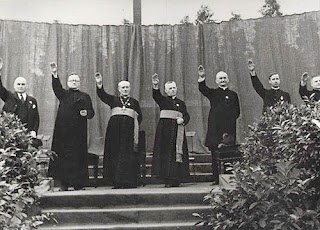 nationalistic, imperialistic, cruel and even idolatrous institutions and causes. Some theologians argue that the Church was ruined as far back as the 4th century, when Constantine made it the official religion of the Roman Empire. The easiest targets for accusing the Church of hypocrisy are the Crusades and Nazi Germany. These days, with all the anti-Islam sentiment, no one wants to talk about these things seriously; but even though these events are "in the past," they cannot be easily brushed aside. That's part of why I recently purchased an iron cross from 1939. An odd purchase, admittedly; but I never want to forget how easily we Christians can whore ourselves out to the peril of those around us and to our own souls.
 We also cannot allow the church to be co-opted even today; I found this picture of the famous Last Supper painting Photoshopped with various trappings of Americanism while looking for a photo of a flag draped over a communion table, which I've heard about happening. The table is not America's table. It is the table of our Lord.
Back to the Crusades and Nazi Germany. We need to admit to these atrocities, to apologize, to make restitution. But we cannot put them behind us, and we cannot wash our hands even of things that happened before we are born. That Christianity has been used as a vehicle of genocide means that the Holocaust could happen again.
And yet. I love the second part of Augustine's quote. The Church is my mother. Regardless of what she may have done, or what we may have done because of her, she is all we have. All the anti-institutional talk floating around in Christianity these days forgets that the institution is all we've got. Yes, it's broken. Yes, it's hypocritical. And I'm not necessarily saying that's OK. We must mourn the brokenness of the church and seek to amend it, with God's help. But we cannot deny that brokenness, or else it will consume us.
The first time I heard this quote (from St. Augustine), I was at first shocked, then extremely pleased.
All my life I've heard people accuse the church of hypocrisy. I would be the last person to argue with that. The church is full of hypocrites and sinners. The moment we stop believing that, we decide we can redeem ourselves, or worse, that we don't need redemption.
I just wrote a paper for my American Christianity class about how the church has always been embedded in its culture. I believe it is important for Christianity to be able to relate to its time and place, and as a lover of the arts, I am especially interested in how the Church interacts with and shapes culture and art. But the church must never be co-opted by its cultural setting.
Unfortunately, the Church regularly has been whored out (hey, I'm just quoting St. Augustine) to
 nationalistic, imperialistic, cruel and even idolatrous institutions and causes. Some theologians argue that the Church was ruined as far back as the 4th century, when Constantine made it the official religion of the Roman Empire. The easiest targets for accusing the Church of hypocrisy are the Crusades and Nazi Germany. These days, with all the anti-Islam sentiment, no one wants to talk about these things seriously; but even though these events are "in the past," they cannot be easily brushed aside. That's part of why I recently purchased an iron cross from 1939. An odd purchase, admittedly; but I never want to forget how easily we Christians can whore ourselves out to the peril of those around us and to our own souls.
 We also cannot allow the church to be co-opted even today; I found this picture of the famous Last Supper painting Photoshopped with various trappings of Americanism while looking for a photo of a flag draped over a communion table, which I've heard about happening. The table is not America's table. It is the table of our Lord.
Back to the Crusades and Nazi Germany. We need to admit to these atrocities, to apologize, to make restitution. But we cannot put them behind us, and we cannot wash our hands even of things that happened before we are born. That Christianity has been used as a vehicle of genocide means that the Holocaust could happen again.
And yet. I love the second part of Augustine's quote. The Church is my mother. Regardless of what she may have done, or what we may have done because of her, she is all we have. All the anti-institutional talk floating around in Christianity these days forgets that the institution is all we've got. Yes, it's broken. Yes, it's hypocritical. And I'm not necessarily saying that's OK. We must mourn the brokenness of the church and seek to amend it, with God's help. But we cannot deny that brokenness, or else it will consume us.
Friday, September 24, 2010
Communion and Protestant Perplexity
Today in worship class, we're talking about the Eucharist (AKA the Lord's Supper, AKA Holy Communion). My interest was piqued when the professor pointed out a paragraph on page 51 of The United Methodist Book of Worship:
"The pastor, or laypersons at the direction of the pastor, may distribute the consecrated bread and cup to sick or homebound persons as soon as feasible following a service of Word and Table as an extension of that service. When this service is used as a distribution of the consecrated bread and cup, the Great Thanksgiving is omitted, but thanks should be given after the bread and cup are received."
Now, I had to ask a question, because I happen to know that this was a topic of debate at the 2008 General Conference of the United Methodist Church. I realize that makes me a huge nerd, but here's why I know that: my dad was a part of that discussion and was texting me as the conversation was unfolding. I was his sort of "phone-a-friend" resource, and he had me look up Article 16 in the Articles of Religion (which are a pretty standard marker of how Protestant theology differs from Catholic theology, and which John Wesley adapted and adopted for Methodists). Here's the relevant section:
"The Sacraments were not ordained of Christ to be gazed upon, or to be carried about; but that we should duly use them."
When I brought this up, the professor pointed out that this article was written as a response to the Catholic doctrine of transubstantiation (which basically means the bread and wine literally become the body and blood of Christ). Catholic practices of adoration (worshipping/praying before the consecrated host), processing the Host in a monstrance (a really pretty display case for the Jesus cookie), Corpus Christi processions, etc., were unsavory to the early Protestants and remain so (except to some Anglicans...which is another story). Article 16 was meant to avoid magical associations made with the Eucharist ("This is my body" in Latin--hoc est corpus meum--became "hocus pocus"), not to keep Aunt Betty from participating in Holy Communion.
Fair point. However, I took issue with the professor's comment that the people at General Conference who debated this issue had forgotten CH13 (our intro church history course here at Duke). I didn't bother mentioning my dad's participation in the discussion with his M.Div. and Ph.D.--but this is my blog, so I can mention it here. :)
OK, so what, I may not agree with my professor entirely. But it did bring up an interesting consideration for me. Is the act of taking blessed bread and wine (er, grape juice) intended to incorporate the sick and homebound into the communal nature of the sacrament? I assume the alternative to bringing the elements to a person is to do the Great Thanksgiving with unconsecrated bread and juice. But should private communion services like that be avoided?
Maybe no one else cares about this, but I used to read liturgical theology for fun, so I do. :)
"The pastor, or laypersons at the direction of the pastor, may distribute the consecrated bread and cup to sick or homebound persons as soon as feasible following a service of Word and Table as an extension of that service. When this service is used as a distribution of the consecrated bread and cup, the Great Thanksgiving is omitted, but thanks should be given after the bread and cup are received."
Now, I had to ask a question, because I happen to know that this was a topic of debate at the 2008 General Conference of the United Methodist Church. I realize that makes me a huge nerd, but here's why I know that: my dad was a part of that discussion and was texting me as the conversation was unfolding. I was his sort of "phone-a-friend" resource, and he had me look up Article 16 in the Articles of Religion (which are a pretty standard marker of how Protestant theology differs from Catholic theology, and which John Wesley adapted and adopted for Methodists). Here's the relevant section:
"The Sacraments were not ordained of Christ to be gazed upon, or to be carried about; but that we should duly use them."
When I brought this up, the professor pointed out that this article was written
 as a response to the Catholic doctrine of transubstantiation (which basically means the bread and wine literally become the body and blood of Christ). Catholic practices of adoration (worshipping/praying before the consecrated host), processing the Host in a monstrance (a really pretty display case for the Jesus cookie), Corpus Christi processions, etc., were unsavory to the early Protestants and remain so (except to some Anglicans...which is another story). Article 16 was meant to avoid magical associations made with the Eucharist ("This is my body" in Latin--hoc est corpus meum--became "hocus pocus"), not to keep Aunt Betty from participating in Holy Communion.
Fair point. However, I took issue with the professor's comment that the people at General Conference who debated this issue had forgotten CH13 (our intro church history course here at Duke). I didn't bother mentioning my dad's participation in the discussion with his M.Div. and Ph.D.--but this is my blog, so I can mention it here. :)
OK, so what, I may not agree with my professor entirely. But it did bring up an interesting consideration for me. Is the act of taking blessed bread and wine (er, grape juice) intended to incorporate the sick and homebound into the communal nature of the sacrament? I assume the alternative to bringing the elements to a person is to do the Great Thanksgiving with unconsecrated bread and juice. But should private communion services like that be avoided?
Maybe no one else cares about this, but I used to read liturgical theology for fun, so I do. :)
Thursday, September 23, 2010
Gospel or Baloney?
I'm usually pretty laid-back. I like to diffuse tense situations with humor. But I can definitely get irritated if the things that are really important to me are dissed or misrepresented.
So, here's what happened to me this past week. I was listening to a sermon where the preacher was talking about the prosperity gospel. Don't worry, he was talking about how much he hates it. He showed this video from John Piper, which is a little intense but still pretty on-point about the whole issue. He warned the congregation against being taken in by the prosperity gospel.
Then he went to make a point which, in essence, I agree with (and which I'll talk more about in a minute), but I was actually almost hurt by how he set it up. What he said was that there's a "gospel" on the other end of the spectrum that reacts to the prosperity gospel and insists that all material possessions are bad. This, he said, is especially big among young Christians today, who live in community and voluntary poverty, which seems nice but, and I quote, is "baloney."
For those of you who don't know, I have been profoundly influenced by Shane Claiborne's book The Irresistible Revolution and the ministry of Rutba House/Jonathan Wilson-Hartgrove, Isaiah House, the Pathways program, New Monasticism and more, all of which focus on intentional Christian community; St. Francis, the champion of voluntary poverty, is a personal hero of mine; I have made 3 trips to Christ in the Desert Monastery, where one of the monks' vows is conversion of life, or poverty; and I currently live in a house with 5 other people where we commit to daily prayer, weekly meals, retreats and more (and our house mentors are the folks at Isaiah House).
So I didn't react well to having all of that called "baloney."
Pause. The point this pastor was trying to make was legitimate. Poverty cannot and should not be glorified or romanticized. Those who choose to live simply defeat their purpose if they are self-righteous about it. Not everyone is called to live in a poor neighborhood and make their own clothes. My housemates and I by no means live in poverty--each of us has our own computer, though the fact that we don't have a TV is sometimes a source of pride for me, which is ridiculous, and I need reminders like this to stay humble. I mean, come on, I didn't even wake up for prayer this morning. I have no moral high ground on which to stand.
But in Matthew 19:21, Jesus says to the young ruler, "sell your possessions, and give the money* to the poor." I hate doing exegesis on this passage. I feel like I either have to compromise the integrity of Jesus' own words or out myself as a complete hypocrite. Mamby-pamby interpretations like "Well, Jesus really just meant that we need to be willing to give up our possessions" just don't do it for me (though I can't unilaterally deny them).
A major reason St. Francis was such a revolutionary character is that he read those words in Matthew and thought he was actually supposed to do what Jesus said. Any good Christian these days knows that's taking things too far. "Baloney," even.
Of course, the church needs rich people. My dad's church in Charlotte is able to do phenomenal missions work thanks to the generosity of a number of wealthy members. But the point of things like the Simple Way (ideally) is that if everyone lived a little more simply, maybe we could distribute wealth more justly. It's like that bumper sticker I see sometimes: "Live simply so that others may simply live."
I genuinely struggle with the question of whether it is sinful to be wealthy. Of course, I'm sitting here on my Macbook wearing a new outfit and zoning out of a graduate course at Duke. I don't have the answers.
Monday, December 28, 2009
Why I wouldn’t want to attend an "open and affirming" church
A few opening words. First, the title of this blog was intentionally worded to elicit an emotional reaction, and I'm betting it did its job for most of you. Before you read further, take a moment to register what your initial thoughts and feelings were upon reading the title. Tuck that away in the back of your mind, and keep reading.
Second, this blog is one I think I meant to write years ago. I did write something that was a pitiful attempt at this, but it was clumsily conceived and written, and it hurt some people. For that I am sorry. This entry is an attempt at an apology and a rewrite. Hopefully this time, what I meant to say will come through more clearly.
With the disclaimers out of the way, I should warn you that if you do not share the basic assumptions I am working with, reading this blog is pointless. So let's get that straight from the get-go, OK? Here are the givens on which my thoughts depend:
• Homosexuals are members of the body of Christ
• Heterosexuals who support LGBT rights are members of the body of Christ
• Heterosexuals who do not support LGBT rights are members of the body of Christ
If you disagree with any of those statements, or think that any one of them is more important than the others, you should proceed with caution, or at least keeping in mind that we might not see eye-to-eye on our basic assumptions. Also, I've had to simplify my categories for the sake of brevity—I am fully aware that there are heterosexuals who do not think homosexuality is a sin but who do not support gay marriage, and that there are plenty of other in-betweens. Forgive me the lack of nuance, and if you don't seem to fit into one of the three groups above, I'd be more than happy to talk with you more individually if you so desire. My thoughts on this subject are continually developing, and I have much to learn.
I also want to say upfront: homosexuality is not an "issue." It has to do with people. And we aren't just talking about behaviors—we're talking about identities. Heterosexuals on both sides of the "issue" (there I go already) sometimes forget that.
So let’s get down to business, shall we? Back to the title of my blog. I would not want to attend an "open and affirming" church. To begin to articulate my thoughts on this, I'll share a bit about one church with which I am fairly familiar. It's a large, mainline Protestant church, historically white and upper-middle-class but recently becoming wonderfully diverse in many ways. There are a number of members who are gay, but the church has not declared itself "open and affirming."
Recently, a few people (who I believe were relatively new to the congregation) began to lobby the pastor to make this move. The pastor dissuaded them. Why? Because if that church were to be branded "open and affirming" or "gay friendly," the one or two members staunchly opposed to homosexuality would come out in full force, and deeply hurtful things would be said. Right now, the church is doing fine at welcoming gays, whether every single member knows it or not. To declare the congregation "open and affirming" would divide the church more than it would unite it.
A similar thing happened with my campus ministry group a few years before I got to college. The LGBT center was asking various organizations to make themselves known as "safe places" by putting stickers from the center on their office doors. Despite the fact that my campus minister and many of the group's members are vocal allies, they decided against it because they did not want to make people who disagreed feel unwelcome. Think about it—if you proclaim yourself "open and affirming," how much meaningful conversation will you have in-house on the topic that isn't one-sided?
See, it's not that I’m opposed to a church being open and affirming in deed. It's just that I wonder what is lost when a church takes the road of declaring itself as such. There are people in my life whom I would miss very much from my congregation if that happened. Some voices would be emboldened, but others would be lost completely.
I once went to a worship service that was so LGBT-friendly that I felt out of place—the songs were all about love in many forms, the vestments were rainbow-colored, even the communion bread had been made with an array of food dyes. I'll admit it—I was uncomfortable. I wasn't even sure I should be there.
The thing is, even though I was personally uneasy in that worship service, it was a truly beautiful event. All around me were people who had been hurt or disenfranchised by society and even by the church, and suddenly they were empowered, they were loved, they knew that at least in that time and that place, they were members of the body of Christ. My own discomfort paled in comparison to the joy and hope I saw in that room. And I couldn't help but think: the way I feel now—some of these people feel that way all the time.
Here's the part where I need help. What the heck are we supposed to do about this? The problem that I recognize in my own argument about avoiding the "open and affirming" stamp is that it can easily be misconstrued to mean, "don't ask, don't tell." But how can we be members of the same body if we don't understand each other? How can we bear one another's burdens if we don’t know what those burdens are?
There's another point I want to make that's going to be tricky to articulate, but I think it's important, so allow me to try. I've heard several gay friends and acquaintances of mine tell me that part of their struggle is that they don't want their lives to be defined by one issue (because even if we acknowledge what I said earlier—that it's not an "issue," it's about people—the world makes it an issue for us). Neither should an issue define our faith. Part of why I was so uncomfortable in the worship service I described earlier is that I feel very strongly that worship is not about us; it's about God. Worship shouldn't be about celebrating gayness—neither should it be about celebrating American-ness (which is why I don't like singing patriotic hymns in church), wealth (which is why the "prosperity gospel" is no gospel at all), racial identity (oh good grief that's a whole other can of worms, not now, please), or any other human quality.
By the way...let me briefly unpack my 3 givens from the beginning of the post. Too often we forget that saying someone is a member of the body of Christ does not mean that you agree with everything they say or do. At the 2008 General Conference of the United Methodist Church, a group tried and failed to change the wording of the paragraph in the social principles about homosexuality. Contrary to what you might have gathered from the intense anger of the opposition, the change would not have condoned homosexuality. What it would have said was that we must acknowledge that many intelligent, faithful people have examined the Bible, church tradition and the issue itself, and they have come down on both sides. The question here in my blog is not the whether homosexuality is right or wrong. I rarely debate that subject anymore, because honestly, I have yet to be thoroughly convinced by anybody one way or the other. I've heard people use the exact same Bible passages to argue opposite points, and at least for me the question has worn out its welcome. I don't want to know whether the church can come up with the perfect answer to every question. I want to know what the church is going to do in the face of uncertainty and disagreement.
A friend of mine (who is gay) once told me that although it's fine for people to disagree theologically with homosexuality, it is never OK to hate. The crucial point here, which far too many people miss, is that disagreement and hatred are not correlative to each other. We can be a part of the body of Christ without being on exactly the same page on everything, if only we can remember that our focus is on God and that the only way we can be healed is by working together towards understanding, not by issuing ultimatums.
So. Can you be gay and be a Christian? Yes. Can you support gays in their sexual identity and lifestyle choices and be a Christian? Yes. Can you hold the belief that homosexuality is a sin and be a Christian? Yes.
In closing, let me ask you to recall that first emotional reaction to the title of my blog. Did you assume I was anti-gay? Did that offend or affirm you? Did your assumptions prior to reading this blog color my status in your mind as a member of the body of Christ—or not? We all need help being Christians. None of us have it right. "All have sinned and fall short of the glory of God." All means all.
Monday, March 31, 2008
The Ground So Dirty
This past weekend, I was at Awakening, a retreat led by Duke's Catholic Student Center. I went last semester as a first-time participant and was on staff for this retreat; for the next one, I'll be on leadership. There are some funny reflections on how a hardcore Methodist wound up in a leadership position for a Catholic retreat, but that's not what this entry is about. This past weekend, I saw the body of Christ in full force. One moment in particular was nothing short of miraculous and summed up what I think a visualization of a truly Christocentric ecclesiology might look like.
On the Awakening retreat, there are a series of talks. The topics are always the same, and they include Faith, Love, Prayer, etc. They are given by students whose lives have been changed by Awakening, and they are always incredible.
This year, a friend of mine delivered the talk on the Mystical Body of Christ (MBOC). We hadn't met long before this weekend, but we both went on the monastery trip this spring break. Naturally, both of us having a strong connection to Awakening, we talked at length about the body of Christ, the Eucharist and ecumenism while we were at the monastery. The MBOC is central to her faith, and I could tell not only in her preparation but also in the talk itself that she poured every ounce of her being into telling us what it meant to be the body of Christ.
Her talk was real, raw and challenging, but the miracle came at the end. Exhorting us to recognize Christ in each other, not in a warm-fuzzy sort of way but in a way that calls us into the suffering of our neighbor, she declared to us that we were Christ to her, and she knelt before us all. Later she told us that she was planning to kneel for about 10 seconds and then go sit down for the reflection song that is played after each talk. But that isn't what happened. She knelt for a few moments, and then there was the sound of chairs being pushed back and shoes scuffling on the floor. All of a sudden, every one of the roughly 100 people in the room was kneeling. It was not a domino effect; it wasn't as if someone thought it was a cool idea and then everyone else followed suit. Everyone just knelt. We all stayed there on our knees throughout the reflection song, "Jesus" by Page France. We knelt, smiling and crying and knowing that we could never look at each other, or anyone else, the same ever again.
I will sing a song to you
And you will shake the ground for me
And the birds and the bees and the old fruit trees
Will spit out songs like gushing streams
And Jesus will come through the ground so dirty
With worms in his hair and a hand so sturdy
To call us his magic, we call him worthy
Jesus came up through the ground so dirty
I will sing a song for you
And you will stomp your feet for me
And the bears and the bees and banana trees
Will play kazoos and tambourines
And Jesus will dance while we drink his wine
With soldiers and thieves and a sword in his side
And we will be joy and we will be right
Jesus will dance while we drink his wine
And Jesus will come through the ground so dirty
With worms in his hair and a hand so sturdy
To call us his magic, we call him worthy
Jesus came up through the ground so dirty
— "Jesus" by Page France
Sunday, January 27, 2008
Christian (Dis)Unity
January 18-25, 2008 marked the 100th anniversary year of the Week of Prayer for Christian Unity. Christians all around the world gathered throughout the week to pray for the unity of the Church. For my part, some of the religious life groups here at Duke organized five consecutive nights of vespers services, each hosted by a different campus ministry. Though the fact that the idea for the services came a little too last-minute to expect large crowds, those of us who did attend were able to meet representatives of other flavors of Christianity at Duke, experience nuances in how each group worships and talk about our own experiences of Christian unity.
The Wesley Fellowship, my campus ministry group, hosted the final service of the week. In lieu of a homily, we chose to split everyone up into small groups with people from different Christian groups for discussion. The questions put to us were simple: first, we were to talk about a time when we experienced disunity in the church; and second, we were to share an example of unity in the church.
Oddly enough, I found that my response to both questions lay in one place: at Eucharist. It was funny too, because in my small group was another Methodist from Wesley and a good friend of mine who is Catholic. So I got to have this conversation with someone with whom I share in the bread and wine on an almost weekly basis, and with another person with whom I most likely will never be able to be in communion.
I'm a Methodist with a very high understanding of the Eucharist (most Methodist call it communion...), so that particular sacrament is extremely important to me. Because of my field of study and my personal interests, I've read an awful lot about the theology of the Eucharist, so I understand the theological underpinnings of the arguments that have resulted in the varying restrictions on who can partake when and where. I'm intrigued by all of this on an intellectual level, but equally so on a personal and liturgical level.
Basically, here's where I see disunity: when, on a Catholic retreat, I sit through Mass and hear most of the very same words uttered in the consecration of the elements, but then must go forward with my arms crossed over my chest, asking for a blessing instead of the physical Host. The closed table has for me a sort of morbid fascination, an abiding sense of sadness but also a deep respect that would lead me never, ever to take a resentful or slighted attitude towards the differences in doctrine that make it so that I cannot receive the Eucharist in a Catholic church. You will never find me whining about why can't we all just get along. The differences are there and they are real. We may say the same words, invoke the same God, but something different happens at that moment of consecration, something that makes my communion and their communion two different things.
But let's not forget that I also named the Eucharist as the point at which I experience Christian unity. It's easy to see how I see it when I'm sharing in communion at my own church, when myself and other Protestants can share in the elements. But I'm not just talking about that—I actually am referring to those times when maybe I can't receive communion. Somehow, even when I've gone up only for a blessing when at Catholic Mass, tied up in the twinge of sadness and separation I feel is a deep sense of connectedness, even with those with whom I cannot sit at the Lord's table. Though the theological specifics may vary, Eucharist is a sharing in the body of Christ, and we, broken and confused, we are the body of Christ.
I know little about the ecumenical movement but I feel more and more called to seek out avenues of reconciliation and unification within the Christian Church. I hope to be able to have more conversations, especially with Catholics, about what keeps us apart at communion, and about what that particular instance implies for the broader body of Christ. I experience sadness when considering the division between Catholics at Protestants at the Eucharist, but it's not personal—it's not about me. In unity and disunity alike, I am not the focal point, but perhaps I can learn to dream of Christ's body made whole, in some form or fashion—if not here and now, then in God's due time.
Subscribe to:
Posts (Atom)
Showing posts with label that they may all be one. Show all posts
Showing posts with label that they may all be one. Show all posts
Tuesday, October 5, 2010
I've Got the Methodist Blues
The other day, while listening to NPR, I heard this song on the radio. "Methodist Blues." I laughed my head off at lyrics like "Problems? We've got a whole long list / But we can't say cause we're Methodist" and "Church is a club, it's downright tribal" and "Our theology gets thinner and thinner / We don't talk about saving the sinner."
Then I recalled a conversation I had with a member at a Methodist church where I'm involved, where he said he and his wife came from different Christian backgrounds and decided on Methodist because it seems to be where anyone can come in. A part of me rejoiced at that, but I began to wonder what Methodism's identity was.
And then I got sad. I recalled Jon Stewart calling United Methodism "the University of Phoenix of religions" (see it in context here). And I remembered Dr. Stanley Hauerwas calling Methodism "flaccid." I thought about a classmate who is considering leaving the Methodist church because he is disappointed in our sacramental practices.
I love how diverse United Methodist congregations are. From high-church liturgical worship to old gospel black church to parishes that more closely resemble Baptist churches, we're all over the map. You aren't necessarily going to get what you expect at a Methodist church, even if you grew up in the denomination.
It's wonderful because it allows for the UMC to bring a myriad of people into communion with one another within the denomination. On the other hand, how much are we really doing that if our church is so fragmented in terms of liturgy, theology, practice and politics? Does a statement issued by the UMC mean anything really?
Yes, the Methodist church has problems. But it is my home, the place where I grew up, the place from which and to which I am called into ministry. Wherever God may take me in my vocation, I doubt you will ever find me far from the Methodist church, even with its tribalism and aversion to facing the reality of sin. My hope is that the Methodist church's true legacy is the evangelical revivalism that John Wesley originally intended.
Saturday, October 2, 2010
The Church Is a Whore
"The Church is a whore, but she's my mother."
The first time I heard this quote (from St. Augustine), I was at first shocked, then extremely pleased.
All my life I've heard people accuse the church of hypocrisy. I would be the last person to argue with that. The church is full of hypocrites and sinners. The moment we stop believing that, we decide we can redeem ourselves, or worse, that we don't need redemption.
I just wrote a paper for my American Christianity class about how the church has always been embedded in its culture. I believe it is important for Christianity to be able to relate to its time and place, and as a lover of the arts, I am especially interested in how the Church interacts with and shapes culture and art. But the church must never be co-opted by its cultural setting.
Unfortunately, the Church regularly has been whored out (hey, I'm just quoting St. Augustine) to nationalistic, imperialistic, cruel and even idolatrous institutions and causes. Some theologians argue that the Church was ruined as far back as the 4th century, when Constantine made it the official religion of the Roman Empire. The easiest targets for accusing the Church of hypocrisy are the Crusades and Nazi Germany. These days, with all the anti-Islam sentiment, no one wants to talk about these things seriously; but even though these events are "in the past," they cannot be easily brushed aside. That's part of why I recently purchased an iron cross from 1939. An odd purchase, admittedly; but I never want to forget how easily we Christians can whore ourselves out to the peril of those around us and to our own souls.We also cannot allow the church to be co-opted even today; I found this picture of the famous Last Supper painting Photoshopped with various trappings of Americanism while looking for a photo of a flag draped over a communion table, which I've heard about happening. The table is not America's table. It is the table of our Lord.
Back to the Crusades and Nazi Germany. We need to admit to these atrocities, to apologize, to make restitution. But we cannot put them behind us, and we cannot wash our hands even of things that happened before we are born. That Christianity has been used as a vehicle of genocide means that the Holocaust could happen again.
And yet. I love the second part of Augustine's quote. The Church is my mother. Regardless of what she may have done, or what we may have done because of her, she is all we have. All the anti-institutional talk floating around in Christianity these days forgets that the institution is all we've got. Yes, it's broken. Yes, it's hypocritical. And I'm not necessarily saying that's OK. We must mourn the brokenness of the church and seek to amend it, with God's help. But we cannot deny that brokenness, or else it will consume us.
Friday, September 24, 2010
Communion and Protestant Perplexity
Today in worship class, we're talking about the Eucharist (AKA the Lord's Supper, AKA Holy Communion). My interest was piqued when the professor pointed out a paragraph on page 51 of The United Methodist Book of Worship:
"The pastor, or laypersons at the direction of the pastor, may distribute the consecrated bread and cup to sick or homebound persons as soon as feasible following a service of Word and Table as an extension of that service. When this service is used as a distribution of the consecrated bread and cup, the Great Thanksgiving is omitted, but thanks should be given after the bread and cup are received."
Now, I had to ask a question, because I happen to know that this was a topic of debate at the 2008 General Conference of the United Methodist Church. I realize that makes me a huge nerd, but here's why I know that: my dad was a part of that discussion and was texting me as the conversation was unfolding. I was his sort of "phone-a-friend" resource, and he had me look up Article 16 in the Articles of Religion (which are a pretty standard marker of how Protestant theology differs from Catholic theology, and which John Wesley adapted and adopted for Methodists). Here's the relevant section:
"The Sacraments were not ordained of Christ to be gazed upon, or to be carried about; but that we should duly use them."
When I brought this up, the professor pointed out that this article was written as a response to the Catholic doctrine of transubstantiation (which basically means the bread and wine literally become the body and blood of Christ). Catholic practices of adoration (worshipping/praying before the consecrated host), processing the Host in a monstrance (a really pretty display case for the Jesus cookie), Corpus Christi processions, etc., were unsavory to the early Protestants and remain so (except to some Anglicans...which is another story). Article 16 was meant to avoid magical associations made with the Eucharist ("This is my body" in Latin--hoc est corpus meum--became "hocus pocus"), not to keep Aunt Betty from participating in Holy Communion.
Fair point. However, I took issue with the professor's comment that the people at General Conference who debated this issue had forgotten CH13 (our intro church history course here at Duke). I didn't bother mentioning my dad's participation in the discussion with his M.Div. and Ph.D.--but this is my blog, so I can mention it here. :)
OK, so what, I may not agree with my professor entirely. But it did bring up an interesting consideration for me. Is the act of taking blessed bread and wine (er, grape juice) intended to incorporate the sick and homebound into the communal nature of the sacrament? I assume the alternative to bringing the elements to a person is to do the Great Thanksgiving with unconsecrated bread and juice. But should private communion services like that be avoided?
Maybe no one else cares about this, but I used to read liturgical theology for fun, so I do. :)
Thursday, September 23, 2010
Gospel or Baloney?
I'm usually pretty laid-back. I like to diffuse tense situations with humor. But I can definitely get irritated if the things that are really important to me are dissed or misrepresented.
So, here's what happened to me this past week. I was listening to a sermon where the preacher was talking about the prosperity gospel. Don't worry, he was talking about how much he hates it. He showed this video from John Piper, which is a little intense but still pretty on-point about the whole issue. He warned the congregation against being taken in by the prosperity gospel.
Then he went to make a point which, in essence, I agree with (and which I'll talk more about in a minute), but I was actually almost hurt by how he set it up. What he said was that there's a "gospel" on the other end of the spectrum that reacts to the prosperity gospel and insists that all material possessions are bad. This, he said, is especially big among young Christians today, who live in community and voluntary poverty, which seems nice but, and I quote, is "baloney."
For those of you who don't know, I have been profoundly influenced by Shane Claiborne's book The Irresistible Revolution and the ministry of Rutba House/Jonathan Wilson-Hartgrove, Isaiah House, the Pathways program, New Monasticism and more, all of which focus on intentional Christian community; St. Francis, the champion of voluntary poverty, is a personal hero of mine; I have made 3 trips to Christ in the Desert Monastery, where one of the monks' vows is conversion of life, or poverty; and I currently live in a house with 5 other people where we commit to daily prayer, weekly meals, retreats and more (and our house mentors are the folks at Isaiah House).
So I didn't react well to having all of that called "baloney."
Pause. The point this pastor was trying to make was legitimate. Poverty cannot and should not be glorified or romanticized. Those who choose to live simply defeat their purpose if they are self-righteous about it. Not everyone is called to live in a poor neighborhood and make their own clothes. My housemates and I by no means live in poverty--each of us has our own computer, though the fact that we don't have a TV is sometimes a source of pride for me, which is ridiculous, and I need reminders like this to stay humble. I mean, come on, I didn't even wake up for prayer this morning. I have no moral high ground on which to stand.
But in Matthew 19:21, Jesus says to the young ruler, "sell your possessions, and give the money* to the poor." I hate doing exegesis on this passage. I feel like I either have to compromise the integrity of Jesus' own words or out myself as a complete hypocrite. Mamby-pamby interpretations like "Well, Jesus really just meant that we need to be willing to give up our possessions" just don't do it for me (though I can't unilaterally deny them).
A major reason St. Francis was such a revolutionary character is that he read those words in Matthew and thought he was actually supposed to do what Jesus said. Any good Christian these days knows that's taking things too far. "Baloney," even.
Of course, the church needs rich people. My dad's church in Charlotte is able to do phenomenal missions work thanks to the generosity of a number of wealthy members. But the point of things like the Simple Way (ideally) is that if everyone lived a little more simply, maybe we could distribute wealth more justly. It's like that bumper sticker I see sometimes: "Live simply so that others may simply live."
I genuinely struggle with the question of whether it is sinful to be wealthy. Of course, I'm sitting here on my Macbook wearing a new outfit and zoning out of a graduate course at Duke. I don't have the answers.
Monday, December 28, 2009
Why I wouldn’t want to attend an "open and affirming" church
A few opening words. First, the title of this blog was intentionally worded to elicit an emotional reaction, and I'm betting it did its job for most of you. Before you read further, take a moment to register what your initial thoughts and feelings were upon reading the title. Tuck that away in the back of your mind, and keep reading.
Second, this blog is one I think I meant to write years ago. I did write something that was a pitiful attempt at this, but it was clumsily conceived and written, and it hurt some people. For that I am sorry. This entry is an attempt at an apology and a rewrite. Hopefully this time, what I meant to say will come through more clearly.
With the disclaimers out of the way, I should warn you that if you do not share the basic assumptions I am working with, reading this blog is pointless. So let's get that straight from the get-go, OK? Here are the givens on which my thoughts depend:
• Homosexuals are members of the body of Christ
• Heterosexuals who support LGBT rights are members of the body of Christ
• Heterosexuals who do not support LGBT rights are members of the body of Christ
If you disagree with any of those statements, or think that any one of them is more important than the others, you should proceed with caution, or at least keeping in mind that we might not see eye-to-eye on our basic assumptions. Also, I've had to simplify my categories for the sake of brevity—I am fully aware that there are heterosexuals who do not think homosexuality is a sin but who do not support gay marriage, and that there are plenty of other in-betweens. Forgive me the lack of nuance, and if you don't seem to fit into one of the three groups above, I'd be more than happy to talk with you more individually if you so desire. My thoughts on this subject are continually developing, and I have much to learn.
I also want to say upfront: homosexuality is not an "issue." It has to do with people. And we aren't just talking about behaviors—we're talking about identities. Heterosexuals on both sides of the "issue" (there I go already) sometimes forget that.
So let’s get down to business, shall we? Back to the title of my blog. I would not want to attend an "open and affirming" church. To begin to articulate my thoughts on this, I'll share a bit about one church with which I am fairly familiar. It's a large, mainline Protestant church, historically white and upper-middle-class but recently becoming wonderfully diverse in many ways. There are a number of members who are gay, but the church has not declared itself "open and affirming."
Recently, a few people (who I believe were relatively new to the congregation) began to lobby the pastor to make this move. The pastor dissuaded them. Why? Because if that church were to be branded "open and affirming" or "gay friendly," the one or two members staunchly opposed to homosexuality would come out in full force, and deeply hurtful things would be said. Right now, the church is doing fine at welcoming gays, whether every single member knows it or not. To declare the congregation "open and affirming" would divide the church more than it would unite it.
A similar thing happened with my campus ministry group a few years before I got to college. The LGBT center was asking various organizations to make themselves known as "safe places" by putting stickers from the center on their office doors. Despite the fact that my campus minister and many of the group's members are vocal allies, they decided against it because they did not want to make people who disagreed feel unwelcome. Think about it—if you proclaim yourself "open and affirming," how much meaningful conversation will you have in-house on the topic that isn't one-sided?
See, it's not that I’m opposed to a church being open and affirming in deed. It's just that I wonder what is lost when a church takes the road of declaring itself as such. There are people in my life whom I would miss very much from my congregation if that happened. Some voices would be emboldened, but others would be lost completely.
I once went to a worship service that was so LGBT-friendly that I felt out of place—the songs were all about love in many forms, the vestments were rainbow-colored, even the communion bread had been made with an array of food dyes. I'll admit it—I was uncomfortable. I wasn't even sure I should be there.
The thing is, even though I was personally uneasy in that worship service, it was a truly beautiful event. All around me were people who had been hurt or disenfranchised by society and even by the church, and suddenly they were empowered, they were loved, they knew that at least in that time and that place, they were members of the body of Christ. My own discomfort paled in comparison to the joy and hope I saw in that room. And I couldn't help but think: the way I feel now—some of these people feel that way all the time.
Here's the part where I need help. What the heck are we supposed to do about this? The problem that I recognize in my own argument about avoiding the "open and affirming" stamp is that it can easily be misconstrued to mean, "don't ask, don't tell." But how can we be members of the same body if we don't understand each other? How can we bear one another's burdens if we don’t know what those burdens are?
There's another point I want to make that's going to be tricky to articulate, but I think it's important, so allow me to try. I've heard several gay friends and acquaintances of mine tell me that part of their struggle is that they don't want their lives to be defined by one issue (because even if we acknowledge what I said earlier—that it's not an "issue," it's about people—the world makes it an issue for us). Neither should an issue define our faith. Part of why I was so uncomfortable in the worship service I described earlier is that I feel very strongly that worship is not about us; it's about God. Worship shouldn't be about celebrating gayness—neither should it be about celebrating American-ness (which is why I don't like singing patriotic hymns in church), wealth (which is why the "prosperity gospel" is no gospel at all), racial identity (oh good grief that's a whole other can of worms, not now, please), or any other human quality.
By the way...let me briefly unpack my 3 givens from the beginning of the post. Too often we forget that saying someone is a member of the body of Christ does not mean that you agree with everything they say or do. At the 2008 General Conference of the United Methodist Church, a group tried and failed to change the wording of the paragraph in the social principles about homosexuality. Contrary to what you might have gathered from the intense anger of the opposition, the change would not have condoned homosexuality. What it would have said was that we must acknowledge that many intelligent, faithful people have examined the Bible, church tradition and the issue itself, and they have come down on both sides. The question here in my blog is not the whether homosexuality is right or wrong. I rarely debate that subject anymore, because honestly, I have yet to be thoroughly convinced by anybody one way or the other. I've heard people use the exact same Bible passages to argue opposite points, and at least for me the question has worn out its welcome. I don't want to know whether the church can come up with the perfect answer to every question. I want to know what the church is going to do in the face of uncertainty and disagreement.
A friend of mine (who is gay) once told me that although it's fine for people to disagree theologically with homosexuality, it is never OK to hate. The crucial point here, which far too many people miss, is that disagreement and hatred are not correlative to each other. We can be a part of the body of Christ without being on exactly the same page on everything, if only we can remember that our focus is on God and that the only way we can be healed is by working together towards understanding, not by issuing ultimatums.
So. Can you be gay and be a Christian? Yes. Can you support gays in their sexual identity and lifestyle choices and be a Christian? Yes. Can you hold the belief that homosexuality is a sin and be a Christian? Yes.
In closing, let me ask you to recall that first emotional reaction to the title of my blog. Did you assume I was anti-gay? Did that offend or affirm you? Did your assumptions prior to reading this blog color my status in your mind as a member of the body of Christ—or not? We all need help being Christians. None of us have it right. "All have sinned and fall short of the glory of God." All means all.
Monday, March 31, 2008
The Ground So Dirty
This past weekend, I was at Awakening, a retreat led by Duke's Catholic Student Center. I went last semester as a first-time participant and was on staff for this retreat; for the next one, I'll be on leadership. There are some funny reflections on how a hardcore Methodist wound up in a leadership position for a Catholic retreat, but that's not what this entry is about. This past weekend, I saw the body of Christ in full force. One moment in particular was nothing short of miraculous and summed up what I think a visualization of a truly Christocentric ecclesiology might look like.
On the Awakening retreat, there are a series of talks. The topics are always the same, and they include Faith, Love, Prayer, etc. They are given by students whose lives have been changed by Awakening, and they are always incredible.
This year, a friend of mine delivered the talk on the Mystical Body of Christ (MBOC). We hadn't met long before this weekend, but we both went on the monastery trip this spring break. Naturally, both of us having a strong connection to Awakening, we talked at length about the body of Christ, the Eucharist and ecumenism while we were at the monastery. The MBOC is central to her faith, and I could tell not only in her preparation but also in the talk itself that she poured every ounce of her being into telling us what it meant to be the body of Christ.
Her talk was real, raw and challenging, but the miracle came at the end. Exhorting us to recognize Christ in each other, not in a warm-fuzzy sort of way but in a way that calls us into the suffering of our neighbor, she declared to us that we were Christ to her, and she knelt before us all. Later she told us that she was planning to kneel for about 10 seconds and then go sit down for the reflection song that is played after each talk. But that isn't what happened. She knelt for a few moments, and then there was the sound of chairs being pushed back and shoes scuffling on the floor. All of a sudden, every one of the roughly 100 people in the room was kneeling. It was not a domino effect; it wasn't as if someone thought it was a cool idea and then everyone else followed suit. Everyone just knelt. We all stayed there on our knees throughout the reflection song, "Jesus" by Page France. We knelt, smiling and crying and knowing that we could never look at each other, or anyone else, the same ever again.
I will sing a song to you
And you will shake the ground for me
And the birds and the bees and the old fruit trees
Will spit out songs like gushing streams
And Jesus will come through the ground so dirty
With worms in his hair and a hand so sturdy
To call us his magic, we call him worthy
Jesus came up through the ground so dirty
I will sing a song for you
And you will stomp your feet for me
And the bears and the bees and banana trees
Will play kazoos and tambourines
And Jesus will dance while we drink his wine
With soldiers and thieves and a sword in his side
And we will be joy and we will be right
Jesus will dance while we drink his wine
And Jesus will come through the ground so dirty
With worms in his hair and a hand so sturdy
To call us his magic, we call him worthy
Jesus came up through the ground so dirty
— "Jesus" by Page France
Sunday, January 27, 2008
Christian (Dis)Unity
January 18-25, 2008 marked the 100th anniversary year of the Week of Prayer for Christian Unity. Christians all around the world gathered throughout the week to pray for the unity of the Church. For my part, some of the religious life groups here at Duke organized five consecutive nights of vespers services, each hosted by a different campus ministry. Though the fact that the idea for the services came a little too last-minute to expect large crowds, those of us who did attend were able to meet representatives of other flavors of Christianity at Duke, experience nuances in how each group worships and talk about our own experiences of Christian unity.
The Wesley Fellowship, my campus ministry group, hosted the final service of the week. In lieu of a homily, we chose to split everyone up into small groups with people from different Christian groups for discussion. The questions put to us were simple: first, we were to talk about a time when we experienced disunity in the church; and second, we were to share an example of unity in the church.
Oddly enough, I found that my response to both questions lay in one place: at Eucharist. It was funny too, because in my small group was another Methodist from Wesley and a good friend of mine who is Catholic. So I got to have this conversation with someone with whom I share in the bread and wine on an almost weekly basis, and with another person with whom I most likely will never be able to be in communion.
I'm a Methodist with a very high understanding of the Eucharist (most Methodist call it communion...), so that particular sacrament is extremely important to me. Because of my field of study and my personal interests, I've read an awful lot about the theology of the Eucharist, so I understand the theological underpinnings of the arguments that have resulted in the varying restrictions on who can partake when and where. I'm intrigued by all of this on an intellectual level, but equally so on a personal and liturgical level.
Basically, here's where I see disunity: when, on a Catholic retreat, I sit through Mass and hear most of the very same words uttered in the consecration of the elements, but then must go forward with my arms crossed over my chest, asking for a blessing instead of the physical Host. The closed table has for me a sort of morbid fascination, an abiding sense of sadness but also a deep respect that would lead me never, ever to take a resentful or slighted attitude towards the differences in doctrine that make it so that I cannot receive the Eucharist in a Catholic church. You will never find me whining about why can't we all just get along. The differences are there and they are real. We may say the same words, invoke the same God, but something different happens at that moment of consecration, something that makes my communion and their communion two different things.
But let's not forget that I also named the Eucharist as the point at which I experience Christian unity. It's easy to see how I see it when I'm sharing in communion at my own church, when myself and other Protestants can share in the elements. But I'm not just talking about that—I actually am referring to those times when maybe I can't receive communion. Somehow, even when I've gone up only for a blessing when at Catholic Mass, tied up in the twinge of sadness and separation I feel is a deep sense of connectedness, even with those with whom I cannot sit at the Lord's table. Though the theological specifics may vary, Eucharist is a sharing in the body of Christ, and we, broken and confused, we are the body of Christ.
I know little about the ecumenical movement but I feel more and more called to seek out avenues of reconciliation and unification within the Christian Church. I hope to be able to have more conversations, especially with Catholics, about what keeps us apart at communion, and about what that particular instance implies for the broader body of Christ. I experience sadness when considering the division between Catholics at Protestants at the Eucharist, but it's not personal—it's not about me. In unity and disunity alike, I am not the focal point, but perhaps I can learn to dream of Christ's body made whole, in some form or fashion—if not here and now, then in God's due time.
Subscribe to:
Posts (Atom)
