Showing posts with label my sin is ever before me. Show all posts
Showing posts with label my sin is ever before me. Show all posts
Tuesday, October 26, 2010
An Environment Where It's OK to Fall
I love Jonathan Acuff. I blogged about his book Stuff Christians Like, based on his blog of the same name. I just came across an article he wrote for CNN, entitled "How to Scandal-Proof Your Church." He lists several wise suggestions, but perhaps my favorite is the first one: "Create an environment where it's OK to fall." So much of the trouble Christians get themselves into comes when sins are repressed, hidden, and generally misunderstood. The church needs to be a place where sins can be confessed in an atmosphere where accountability is real, but so are expectations. If Christianity is all about maintaining an image, we (myself included) will sooner lie to keep up the facade than confess failings...and that is not what the Gospel calls us to do to ourselves and to each other.

Repentance of an Anti-Gay Bigot (a quote from Mark Osler)
"Are gays and lesbians sinners? It doesn't seem that way to me (other than the way in which we are all sinners), but at some level I really don't care. If it is a sin, it is not my sin. The sin that I need to discern, root out and identify is my own. One of those sins has been bigotry and senseless cruelty. I atone for and seek forgiveness for that now and here." — Mark Osler (read more here)
Saturday, October 2, 2010
The Church Is a Whore
"The Church is a whore, but she's my mother."
The first time I heard this quote (from St. Augustine), I was at first shocked, then extremely pleased.
All my life I've heard people accuse the church of hypocrisy. I would be the last person to argue with that. The church is full of hypocrites and sinners. The moment we stop believing that, we decide we can redeem ourselves, or worse, that we don't need redemption.
I just wrote a paper for my American Christianity class about how the church has always been embedded in its culture. I believe it is important for Christianity to be able to relate to its time and place, and as a lover of the arts, I am especially interested in how the Church interacts with and shapes culture and art. But the church must never be co-opted by its cultural setting.
Unfortunately, the Church regularly has been whored out (hey, I'm just quoting St. Augustine) to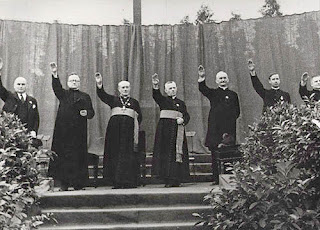 nationalistic, imperialistic, cruel and even idolatrous institutions and causes. Some theologians argue that the Church was ruined as far back as the 4th century, when Constantine made it the official religion of the Roman Empire. The easiest targets for accusing the Church of hypocrisy are the Crusades and Nazi Germany. These days, with all the anti-Islam sentiment, no one wants to talk about these things seriously; but even though these events are "in the past," they cannot be easily brushed aside. That's part of why I recently purchased an iron cross from 1939. An odd purchase, admittedly; but I never want to forget how easily we Christians can whore ourselves out to the peril of those around us and to our own souls.
 We also cannot allow the church to be co-opted even today; I found this picture of the famous Last Supper painting Photoshopped with various trappings of Americanism while looking for a photo of a flag draped over a communion table, which I've heard about happening. The table is not America's table. It is the table of our Lord.
Back to the Crusades and Nazi Germany. We need to admit to these atrocities, to apologize, to make restitution. But we cannot put them behind us, and we cannot wash our hands even of things that happened before we are born. That Christianity has been used as a vehicle of genocide means that the Holocaust could happen again.
And yet. I love the second part of Augustine's quote. The Church is my mother. Regardless of what she may have done, or what we may have done because of her, she is all we have. All the anti-institutional talk floating around in Christianity these days forgets that the institution is all we've got. Yes, it's broken. Yes, it's hypocritical. And I'm not necessarily saying that's OK. We must mourn the brokenness of the church and seek to amend it, with God's help. But we cannot deny that brokenness, or else it will consume us.
The first time I heard this quote (from St. Augustine), I was at first shocked, then extremely pleased.
All my life I've heard people accuse the church of hypocrisy. I would be the last person to argue with that. The church is full of hypocrites and sinners. The moment we stop believing that, we decide we can redeem ourselves, or worse, that we don't need redemption.
I just wrote a paper for my American Christianity class about how the church has always been embedded in its culture. I believe it is important for Christianity to be able to relate to its time and place, and as a lover of the arts, I am especially interested in how the Church interacts with and shapes culture and art. But the church must never be co-opted by its cultural setting.
Unfortunately, the Church regularly has been whored out (hey, I'm just quoting St. Augustine) to
 nationalistic, imperialistic, cruel and even idolatrous institutions and causes. Some theologians argue that the Church was ruined as far back as the 4th century, when Constantine made it the official religion of the Roman Empire. The easiest targets for accusing the Church of hypocrisy are the Crusades and Nazi Germany. These days, with all the anti-Islam sentiment, no one wants to talk about these things seriously; but even though these events are "in the past," they cannot be easily brushed aside. That's part of why I recently purchased an iron cross from 1939. An odd purchase, admittedly; but I never want to forget how easily we Christians can whore ourselves out to the peril of those around us and to our own souls.
 We also cannot allow the church to be co-opted even today; I found this picture of the famous Last Supper painting Photoshopped with various trappings of Americanism while looking for a photo of a flag draped over a communion table, which I've heard about happening. The table is not America's table. It is the table of our Lord.
Back to the Crusades and Nazi Germany. We need to admit to these atrocities, to apologize, to make restitution. But we cannot put them behind us, and we cannot wash our hands even of things that happened before we are born. That Christianity has been used as a vehicle of genocide means that the Holocaust could happen again.
And yet. I love the second part of Augustine's quote. The Church is my mother. Regardless of what she may have done, or what we may have done because of her, she is all we have. All the anti-institutional talk floating around in Christianity these days forgets that the institution is all we've got. Yes, it's broken. Yes, it's hypocritical. And I'm not necessarily saying that's OK. We must mourn the brokenness of the church and seek to amend it, with God's help. But we cannot deny that brokenness, or else it will consume us.
Tuesday, September 28, 2010
Please Don't Forgive Me
Over the summer, I got into the TV show Buffy the Vampire Slayer. (Yes, I know I'm a little behind.) I'm now on season 6. The other day, I watched an episode where Buffy confesses to a friend for the first time that she has been sleeping with Spike, a vampire whom she hates with every fiber of her being. Tara is reasonably concerned and doesn't condone Buffy's actions, but she does comfort her--we all make mistakes, she says; it's OK; you've been going through a lot lately. At that, Buffy breaks down and makes this pitiful plea: "Please don't forgive me." She wants to be told that something is wrong with her, that she's bad and deserves to be punished; instead, she is receiving grace, and it is more than she can take.
The scene moved me, because I know exactly how that feels. Sometimes, forgiveness can be an even heavier burden to bear than sin--or maybe that's just my prideful, fallen nature talking. But forgiveness requires confession, vulnerability, being known in your most humiliating and painful moments. No one wants to be known that well, and even when we are, we want enablers, people who will help us punish ourselves. Hurt can become familiar, comfortable even, and healing threatens to introduce unfamiliarity.
This morning, I read Luke 5:1-11, where Jesus has the fisherman cast their nets until the boats are sinking with so much fish, and then calls them to become fishers of people. In verse 8, Peter reacts a bit surprisingly to Jesus' show of power: "Go away from me, Lord, for I am a sinful man!"
Does Peter not know that sending Jesus away is the surest way to remain in his sin?
I bet he does. Sin is easy. Forgiveness--especially receiving it--is hard.
The scene moved me, because I know exactly how that feels. Sometimes, forgiveness can be an even heavier burden to bear than sin--or maybe that's just my prideful, fallen nature talking. But forgiveness requires confession, vulnerability, being known in your most humiliating and painful moments. No one wants to be known that well, and even when we are, we want enablers, people who will help us punish ourselves. Hurt can become familiar, comfortable even, and healing threatens to introduce unfamiliarity.
This morning, I read Luke 5:1-11, where Jesus has the fisherman cast their nets until the boats are sinking with so much fish, and then calls them to become fishers of people. In verse 8, Peter reacts a bit surprisingly to Jesus' show of power: "Go away from me, Lord, for I am a sinful man!"
Does Peter not know that sending Jesus away is the surest way to remain in his sin?
I bet he does. Sin is easy. Forgiveness--especially receiving it--is hard.
Sunday, August 29, 2010
A Rant
I'm going to stop arguing online about Islam and the proposed mosque in New York. I'm tired of and saddened by the fact that I feel like I'm on a completely different planet from people who disagree with me, especially brothers and sisters in Christ.
But first, I have to express my outrage at the fact that the site of the new Islamic center in Murfreesboro, TN has been torched.
[Just to warn you: this is going to be a rant. Don't bother picking apart my rhetoric. I'm angry.]
No. This is outrageous. Whether your argument against the building of mosques in this country stems from an "American" or a "Christian" argument, THIS IS WRONG. I know most people opposed to building the mosque in NY would never condone such action, but especially to folks who support stuff like burning the Quran--do you not see the slippery slope here?
This video is obviously a humor bit, but what I find terrifying is that people can hear what this woman (the leader of the anti-mosque movement in Murfreesboro) is saying and not realize that IT IS INSANE. I've been trying really hard to be gracious and to try to see things from the other side, and let me just say that I know that there are reasonable arguments against the mosque in NY, and I know there are concerns about violence in the Quran (to which I respond, ever read the story about Elisha having she-bears tear children apart for calling him "baldhead" or the psalm about dashing children's heads against the rocks?), but THIS IS RIDICULOUS.
Please. Please, set aside the numbers and statistics that come from God-knows-where. Go talk to a Muslim. When I took an Islamic civilization course in undergrad, my spiritual life was inspired to new life by hearing from several teachers of Sufism (Islamic mysticism). We have something to learn from Islam. And if we choose only to learn from jihadists, we are no better than they are.
I can't even laugh at this video right now.
But first, I have to express my outrage at the fact that the site of the new Islamic center in Murfreesboro, TN has been torched.
[Just to warn you: this is going to be a rant. Don't bother picking apart my rhetoric. I'm angry.]
No. This is outrageous. Whether your argument against the building of mosques in this country stems from an "American" or a "Christian" argument, THIS IS WRONG. I know most people opposed to building the mosque in NY would never condone such action, but especially to folks who support stuff like burning the Quran--do you not see the slippery slope here?
This video is obviously a humor bit, but what I find terrifying is that people can hear what this woman (the leader of the anti-mosque movement in Murfreesboro) is saying and not realize that IT IS INSANE. I've been trying really hard to be gracious and to try to see things from the other side, and let me just say that I know that there are reasonable arguments against the mosque in NY, and I know there are concerns about violence in the Quran (to which I respond, ever read the story about Elisha having she-bears tear children apart for calling him "baldhead" or the psalm about dashing children's heads against the rocks?), but THIS IS RIDICULOUS.
Please. Please, set aside the numbers and statistics that come from God-knows-where. Go talk to a Muslim. When I took an Islamic civilization course in undergrad, my spiritual life was inspired to new life by hearing from several teachers of Sufism (Islamic mysticism). We have something to learn from Islam. And if we choose only to learn from jihadists, we are no better than they are.
I can't even laugh at this video right now.
| The Daily Show With Jon Stewart | Mon - Thurs 11p / 10c | |||
| Tennessee No Evil | ||||
| ||||
Thursday, July 1, 2010
Tea Party Jesus: The Words of Christians in the Mouth of Christ
This blog is hilarious. And condemning. And inappropriate. But it's not the authors who are being necessarily inappropriate--it's Christians. These are direct quotes from high-profile, self-proclaimed Christians, put into perspective by putting them in Jesus' mouth. See my earlier post that touches on Christians being jerks.
Here are a few favorites so far (I just discovered this blog):
 (Tom Mullins, May 2010)
 (Glen Beck, March 2008)
Here are a few favorites so far (I just discovered this blog):
 (Tom Mullins, May 2010)
 (Glen Beck, March 2008)
Monday, July 27, 2009
Glow Sticks
(This post totally steals an idea from my boyfriend, Gary Mitchell, www.myspace.com/visionrise.)
Consider a glow stick. (Bear with me.) Now, erase everything you know about glow sticks. In fact, forget the "glow" part. We'll call them...all right, I can't think of a great name, so just imagine all you know is that these are small liquid-filled plastic sticks.
What uses could you think of for such an object? Today, my youth came up with a few: paperweight, necklace, Christmas tree decoration, action figure stand; you could play catch with it or use it as a toy for your dog to fetch. You can certainly do some things with it.
But we all know what the real purpose of a glow stick is--I mean, it's right there in the name! A glow stick is supposed to glow. And how do we get it to glow?
Exactly. We break it. Until it is broken, a glow stick can never fulfill its real purpose. It can be lots of different things, but never what it was meant to be. With the breaking comes light.
In college, my boyfriend and his roommate had a tradition surrounding glow sticks. Every time someone they knew came to Christ, they would break one. They collected these glow sticks as reminders of their friends who had been broken--who had surrendered to Christ, admitted their sin and need of forgiveness, submitted to the will of God.
The glow stick image goes along well with 2 Corinthians 12:9--"My grace is sufficient for you, for power is made perfect in weakness." In our pain and suffering, God enters in to reconcile us to him and to make us whole in his love. In our brokenness, God shines a light we cannot see when we think we've got everything together.
Earlier this summer, I marked the 2nd anniversary of an extremely painful event. After helping me turn the day into a celebration and helping to give me good memories of that date, Gary brought out a glow stick. I had heard his explanation before, and I admit I had thought it a little cheesy at first. But wept as he broke the stick and gave it to me, saying that he was proud of me and he could see how God was using me in my weakness to serve others.
Today, I did a glow stick demonstration with my youth at the end of a discussion about why bad things happen. Afterwards, I was wearing my sample glow stick around my neck, and a question from one of the kids showed me another dimension to the metaphor: "Can you turn it off?" asked Kristopher. "No. No, you can't." I smiled. Sure, it's an imperfect comparison, because glow sticks do fade...but then again, maybe that's about right. We often need to be reminded of our need of God. Maybe we don't have to be broken drastically over and over again, but faith is not a one-time thing where you get it or you don't--it's a process. Some of us might need to go through Wal-Mart's entire stock of glow sticks before we get it.
Consider a glow stick. (Bear with me.) Now, erase everything you know about glow sticks. In fact, forget the "glow" part. We'll call them...all right, I can't think of a great name, so just imagine all you know is that these are small liquid-filled plastic sticks.
What uses could you think of for such an object? Today, my youth came up with a few: paperweight, necklace, Christmas tree decoration, action figure stand; you could play catch with it or use it as a toy for your dog to fetch. You can certainly do some things with it.
But we all know what the real purpose of a glow stick is--I mean, it's right there in the name! A glow stick is supposed to glow. And how do we get it to glow?
Exactly. We break it. Until it is broken, a glow stick can never fulfill its real purpose. It can be lots of different things, but never what it was meant to be. With the breaking comes light.
In college, my boyfriend and his roommate had a tradition surrounding glow sticks. Every time someone they knew came to Christ, they would break one. They collected these glow sticks as reminders of their friends who had been broken--who had surrendered to Christ, admitted their sin and need of forgiveness, submitted to the will of God.
The glow stick image goes along well with 2 Corinthians 12:9--"My grace is sufficient for you, for power is made perfect in weakness." In our pain and suffering, God enters in to reconcile us to him and to make us whole in his love. In our brokenness, God shines a light we cannot see when we think we've got everything together.
Earlier this summer, I marked the 2nd anniversary of an extremely painful event. After helping me turn the day into a celebration and helping to give me good memories of that date, Gary brought out a glow stick. I had heard his explanation before, and I admit I had thought it a little cheesy at first. But wept as he broke the stick and gave it to me, saying that he was proud of me and he could see how God was using me in my weakness to serve others.
Today, I did a glow stick demonstration with my youth at the end of a discussion about why bad things happen. Afterwards, I was wearing my sample glow stick around my neck, and a question from one of the kids showed me another dimension to the metaphor: "Can you turn it off?" asked Kristopher. "No. No, you can't." I smiled. Sure, it's an imperfect comparison, because glow sticks do fade...but then again, maybe that's about right. We often need to be reminded of our need of God. Maybe we don't have to be broken drastically over and over again, but faith is not a one-time thing where you get it or you don't--it's a process. Some of us might need to go through Wal-Mart's entire stock of glow sticks before we get it.
Sunday, December 21, 2008
Ashamed to Be White
I’ve known for a while that racial reconciliation was going to be a particular focus of my ministry and vocation. Lately, I’ve embraced that with full force, especially in my choices for reading material—I’ve read Stokely Carmichael’s Black Power and The Autobiography of Malcolm X, and I’m almost done with James H. Cone’s Black Theology and Black Power.
People don’t understand my interest in and stance on race issues (I’m white, by the way). They tell me that it’s the 21st century, that the 1960s were a long time ago. They tell me race isn’t as much of an issue anymore. When Obama was elected, I wanted to talk about the significance of his racial background but was told by several people that it didn’t matter that he was black. True, his ethnicity has nothing to do with how well he’ll lead the country, but I couldn’t help but notice that everyone who said this to me was white. My black friends knew it mattered that they had a black president.
You can tell me that race isn’t an issue, even that Obama’s victory ushered in a new era in race relations, but I won’t believe you. After the election, students at N.C. State wrote graffiti on a wall on campus with such hateful messages as “Hang Obama by a noose” and “Shoot that n----- in the head.” And this at a respected institution of higher learning. What were you saying about race not being an issue anymore?
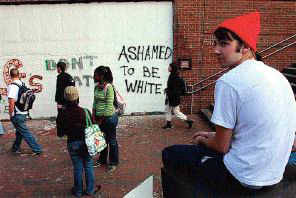
Now it’s time to relate all of this to Christianity. What is the Church supposed to do about the lingering racism that festers in our nation? One student’s response to the graffiti at NSCU offered a partial answer: when the wall had been whitewashed, he wrote, “Ashamed to be white.” Malcolm X and Carmichael both believed that whites admitting the sin of racism was the first step to the emancipation of blacks—and, as Cone would add, the emancipation of whites, for “the man who enslaves another enslaves himself.” Most churches confess corporate sin on at least a weekly basis. How do we confess the inherited sin of racism?
One answer comes from Malcolm Boyd in his book Are You Running With Me, Jesus? “During a Freedom Ride in the Deep South in 1961, one of my fellow Episcopalian priests said: ‘It seems to me this is really a kind of prayer—a kind of corporate confession of sin.’” This aligns with James H. Cone’s insistence that Christ’s very being is tied up with his identification with the oppressed peoples of the world—and that the Church must enter into a radical identification with that oppressed Christ and our neighbors with whom he shares his person.
The first step towards reconciliation is confession. The off-Broadway hit Avenue Q, although crass at times (or half the time) makes a good point in its song “Everyone’s a Little Bit Racist.” If we insist that race is not an issue, we only prop up old systems of injustice. The Church must help confront Americans with the sin of racism. And the Church must provide a model for radical identification with the oppressed. To do otherwise is to deny Christ.

People don’t understand my interest in and stance on race issues (I’m white, by the way). They tell me that it’s the 21st century, that the 1960s were a long time ago. They tell me race isn’t as much of an issue anymore. When Obama was elected, I wanted to talk about the significance of his racial background but was told by several people that it didn’t matter that he was black. True, his ethnicity has nothing to do with how well he’ll lead the country, but I couldn’t help but notice that everyone who said this to me was white. My black friends knew it mattered that they had a black president.
You can tell me that race isn’t an issue, even that Obama’s victory ushered in a new era in race relations, but I won’t believe you. After the election, students at N.C. State wrote graffiti on a wall on campus with such hateful messages as “Hang Obama by a noose” and “Shoot that n----- in the head.” And this at a respected institution of higher learning. What were you saying about race not being an issue anymore?
Now it’s time to relate all of this to Christianity. What is the Church supposed to do about the lingering racism that festers in our nation? One student’s response to the graffiti at NSCU offered a partial answer: when the wall had been whitewashed, he wrote, “Ashamed to be white.” Malcolm X and Carmichael both believed that whites admitting the sin of racism was the first step to the emancipation of blacks—and, as Cone would add, the emancipation of whites, for “the man who enslaves another enslaves himself.” Most churches confess corporate sin on at least a weekly basis. How do we confess the inherited sin of racism?
One answer comes from Malcolm Boyd in his book Are You Running With Me, Jesus? “During a Freedom Ride in the Deep South in 1961, one of my fellow Episcopalian priests said: ‘It seems to me this is really a kind of prayer—a kind of corporate confession of sin.’” This aligns with James H. Cone’s insistence that Christ’s very being is tied up with his identification with the oppressed peoples of the world—and that the Church must enter into a radical identification with that oppressed Christ and our neighbors with whom he shares his person.
The first step towards reconciliation is confession. The off-Broadway hit Avenue Q, although crass at times (or half the time) makes a good point in its song “Everyone’s a Little Bit Racist.” If we insist that race is not an issue, we only prop up old systems of injustice. The Church must help confront Americans with the sin of racism. And the Church must provide a model for radical identification with the oppressed. To do otherwise is to deny Christ.
Tuesday, February 5, 2008
L.E.N.T.
I remember being in about 6th grade when a guest speaker at youth group told us to think of this handy acronym for the word "Lent": Let's Eliminate Negative Thinking. At the time, I thought that was a great idea. At the time, I was maybe 11 years old.
Maybe this guy was trying to encourage us to give up destructive mindsets and attitudes instead of just avoiding chocolate for 40 days. I somehow doubt that. The thing is, if Lent is a time of repentance (and by "if" I mean clearly it is), it makes no sense to eliminate negative thinking, because acknowledging sin tends to have some negative connotations for us, the sinners. Psalm 51, one of the great biblical pleas for forgiveness, is full of negative thinking. "For I know my transgressions, and my sin is ever before me" (v. 3). "Indeed, I was born guilty, a sinner when my mother conceived me" (v. 5). Lighten up, Dave!
I'll admit, I'm a bit of a weirdo when it comes to this sort of thing. I love Lent. Fat Tuesday's fun, but I can't wait for Ash Wednesday. My favorite holiday is Good Friday; the service where I feel most spiritually aware is the Tenebrae. I know this is not normal. Liturgically speaking, I love Christmas and Easter's even better, but the external trappings of those holidays (in-laws, last-minute shopping trips, lilies in the sanctuary that make me sneeze) often succeed in distracting me from the true celebration at hand. The literal stripping of the sanctuary on Maundy Thursday mirrors the way in which the days between the commemoration of the Last Supper and the festival of Christ's resurrection are figuratively stripped of decorative and secular white noise.
I haven't quite hammered out what my Lenten discipline will entail this year. I'll commit to attending morning prayer at the Divinity School 3 times a week (if not more) and I'd love to give up caffeine...but the point is, that goofy little acronym I've heard so many times completely misses the point of Lent. If we are seriously to confess and repent of our sins, that means we must acknowledge them. Confronting the sin in our lives is never a pleasant experience. It's not all gloom and doom, of course; we know that Easter's coming, that Jesus saved, saves and is saving us from the fear of sin and death. There is freedom in confession, joy in repentance. But we have to be willing to face the fact that we're a mess before we can ask Jesus to clean it up.
Maybe this guy was trying to encourage us to give up destructive mindsets and attitudes instead of just avoiding chocolate for 40 days. I somehow doubt that. The thing is, if Lent is a time of repentance (and by "if" I mean clearly it is), it makes no sense to eliminate negative thinking, because acknowledging sin tends to have some negative connotations for us, the sinners. Psalm 51, one of the great biblical pleas for forgiveness, is full of negative thinking. "For I know my transgressions, and my sin is ever before me" (v. 3). "Indeed, I was born guilty, a sinner when my mother conceived me" (v. 5). Lighten up, Dave!
I'll admit, I'm a bit of a weirdo when it comes to this sort of thing. I love Lent. Fat Tuesday's fun, but I can't wait for Ash Wednesday. My favorite holiday is Good Friday; the service where I feel most spiritually aware is the Tenebrae. I know this is not normal. Liturgically speaking, I love Christmas and Easter's even better, but the external trappings of those holidays (in-laws, last-minute shopping trips, lilies in the sanctuary that make me sneeze) often succeed in distracting me from the true celebration at hand. The literal stripping of the sanctuary on Maundy Thursday mirrors the way in which the days between the commemoration of the Last Supper and the festival of Christ's resurrection are figuratively stripped of decorative and secular white noise.
I haven't quite hammered out what my Lenten discipline will entail this year. I'll commit to attending morning prayer at the Divinity School 3 times a week (if not more) and I'd love to give up caffeine...but the point is, that goofy little acronym I've heard so many times completely misses the point of Lent. If we are seriously to confess and repent of our sins, that means we must acknowledge them. Confronting the sin in our lives is never a pleasant experience. It's not all gloom and doom, of course; we know that Easter's coming, that Jesus saved, saves and is saving us from the fear of sin and death. There is freedom in confession, joy in repentance. But we have to be willing to face the fact that we're a mess before we can ask Jesus to clean it up.
Friday, November 16, 2007
Confession
I recently went on a retreat with the Catholic Student Center here at Duke. The Awakening retreat happens every semester, and Duke just had their ninth one. Texas A&M, who passed the retreat tradition on to our school, will have Aggie Awakening #82 in the spring.
Although the whole weekend was an incredible experience for me—in ways I could not have anticipated or even hoped for—one thing in particular that we did the first night of Awakening got me thinking. After we had all been introduced, we ate dinner and heard a talk from a fellow student. Then the priest, Father Joe, stood up and announced that we would be participating in the sacrament of reconciliation that night.
I was fascinated. Having grown up United Methodist, I was used to the communal prayer of confession that we say together during worship, so the idea of confessing individually to a priest was new for me. I asked a friend if I could confess even if I were Protestant (the only one there, I should add), and when he said yes, I went in to see one of the priests who were stationed in various rooms around our retreat site.
As soon as I sat down, I announced that I was Protestant and had no idea what I was doing. The priest was very friendly and helpful, explaining the practice of confession to me before listening to me talk. When I was done, he said that they usually assign penance. Penance?! I thought. How cool!! I had to say three Our Fathers and was told to work on a relationship I had confessed to have been neglecting.
Since this experience, I've thought a lot about what it means to confess one's sins, and whether Protestants are missing out on an important part of the Christian life by foregoing individual confession. Certainly to confess the corporate sin of the church in one voice is vital, especially before taking part in the Eucharist. Then, too, many Protestants participate in accountability groups that require them to be honest about their sins and to be held to a standard of Christian living by fellow believers.
I wonder if it would behoove all Christians, Catholics and non-Catholics alike, to confess not only to the sins of the whole body of Christ but also to their own specific sins. Confessing to that priest encouraged me to take specific actions to ameliorate a situation with a loved one. On the ride home, I listened as one of the freshmen I was driving called her parents and asked their permission to take part in an activity about which she had been lying to them. She had confessed this to the priest, he had told her to be truthful with them—and she had done it.
The corporate prayer of confession may be an important way for a worshiping body to acknowledge shared sin, but does it motivate the individual to make real changes to combat his or her own shortcomings? Even if it means doing something as simple as being in truth-telling relationships of Christian accountability, I think Protestants especially ought to explore possibilities for confessing individual sin and being held responsible for answering to them.
Although the whole weekend was an incredible experience for me—in ways I could not have anticipated or even hoped for—one thing in particular that we did the first night of Awakening got me thinking. After we had all been introduced, we ate dinner and heard a talk from a fellow student. Then the priest, Father Joe, stood up and announced that we would be participating in the sacrament of reconciliation that night.
I was fascinated. Having grown up United Methodist, I was used to the communal prayer of confession that we say together during worship, so the idea of confessing individually to a priest was new for me. I asked a friend if I could confess even if I were Protestant (the only one there, I should add), and when he said yes, I went in to see one of the priests who were stationed in various rooms around our retreat site.
As soon as I sat down, I announced that I was Protestant and had no idea what I was doing. The priest was very friendly and helpful, explaining the practice of confession to me before listening to me talk. When I was done, he said that they usually assign penance. Penance?! I thought. How cool!! I had to say three Our Fathers and was told to work on a relationship I had confessed to have been neglecting.
Since this experience, I've thought a lot about what it means to confess one's sins, and whether Protestants are missing out on an important part of the Christian life by foregoing individual confession. Certainly to confess the corporate sin of the church in one voice is vital, especially before taking part in the Eucharist. Then, too, many Protestants participate in accountability groups that require them to be honest about their sins and to be held to a standard of Christian living by fellow believers.
I wonder if it would behoove all Christians, Catholics and non-Catholics alike, to confess not only to the sins of the whole body of Christ but also to their own specific sins. Confessing to that priest encouraged me to take specific actions to ameliorate a situation with a loved one. On the ride home, I listened as one of the freshmen I was driving called her parents and asked their permission to take part in an activity about which she had been lying to them. She had confessed this to the priest, he had told her to be truthful with them—and she had done it.
The corporate prayer of confession may be an important way for a worshiping body to acknowledge shared sin, but does it motivate the individual to make real changes to combat his or her own shortcomings? Even if it means doing something as simple as being in truth-telling relationships of Christian accountability, I think Protestants especially ought to explore possibilities for confessing individual sin and being held responsible for answering to them.
Friday, October 19, 2007


Wednesday, August 29, 2007
Our Desires Are Too Weak
O Lord, I do not know what to ask of you.
You alone know what are my true needs.
You love me more than I myself know how to love.
I dare not ask either a cross or consolation.
I can only wait on you.
My heart is open to you. Amen. — Philaret of Moscow
John Piper (of whom, to be honest, I am not a huge fan, but I think he got this right) said in a sermon that he does not preach to felt needs. Although it is obviously important that a pastor be able to care for and tend to the needs of the members of a congregation/community, perhaps the greatest service a pastor can do for parishioners is to show them that their desires are disordered, weak, and in need of extensive renovation. C. S. Lewis once said, "Our Lord finds our desires not too strong but too weak." Desire drives human existence, but we desire the wrong things and whatever part of us that might approach or border on correct desire is feeble and flimsy at best. We do not know what we need or even what we want, because the things we think we want and need will never bring satisfaction. If our desire is for money, we fall into the sin of greed; if our desire is for esteem, we fall into the sin of pride; if our desire is for food, we fall into the sin of gluttony; if our desire is for sex, we fall into the sin of lust; and on and on. These desires are disordered and weak. These desires can make our lives seem worth living in the eyes of the world, but they ruin our lives in the eyes of God. We were made to desire God so passionately that this desire would thoroughly ruin our lives on this earth. Jesus did not say that if we follow him, everyone will love us; he said, "If the world hates you, be aware that it hated me before it hated you" (John 15:18).
Julian of Norwich knew full well that if she were to pursue anything short of the fullness of God, she would always find herself lacking, her needs and wants unfulfilled. In her record of the divine revelations, she prays, "God, of your goodness give me yourself, for you are sufficient for me. I cannot properly ask anything less, to be worthy of you. If I were to ask less, I should always be in want. In you alone do I have all." This is the desire for which we were created: to be worthy to abide in the fullness and mercy of God. Before partaking in Mass, the monks of Christ in the Desert Monastery in New Mexico pray this simple request: "Lord, I am not worthy to receive you. Only say the word, and I will be." There are desires that we can try to fulfill on our own. We can seek out power and prestige to sate our thirst for the approval of others; we can find someone who will sleep with us and slake our lust. But when our desires are reoriented and strengthened, we find that the only one who can satisfy those desires is God.
But here's the question: what can a preacher say every Sunday in the pulpit to shape and convert the desires of those in the congregation? How can a minister strike a balance between taking good pastoral care of people while turning their worlds on end? It seems to me that the task of caring for and tending to the perceived wants and needs of people while simultaneously telling them that their desires are misguided and weak would be extremely difficult and even delicate. Too often I feel that pastors spend so much time trying to meet people where they are that they forget that there is a better place to which they need to help bring them. On the other hand, plenty of people speak the hard truth that we want the wrong things and that the desires we do have are weak and pathetic, but in such a way that those who hear it feel attacked rather than loved and challenged. This is one of the most daunting of the tasks before me: to love and cherish those to whom I will one day minister as they are while shaking them out of the slumber that lets us be lulled into complacency by desires that do not align with the reality that we were made to want God more than anything else.
You alone know what are my true needs.
You love me more than I myself know how to love.
I dare not ask either a cross or consolation.
I can only wait on you.
My heart is open to you. Amen. — Philaret of Moscow
John Piper (of whom, to be honest, I am not a huge fan, but I think he got this right) said in a sermon that he does not preach to felt needs. Although it is obviously important that a pastor be able to care for and tend to the needs of the members of a congregation/community, perhaps the greatest service a pastor can do for parishioners is to show them that their desires are disordered, weak, and in need of extensive renovation. C. S. Lewis once said, "Our Lord finds our desires not too strong but too weak." Desire drives human existence, but we desire the wrong things and whatever part of us that might approach or border on correct desire is feeble and flimsy at best. We do not know what we need or even what we want, because the things we think we want and need will never bring satisfaction. If our desire is for money, we fall into the sin of greed; if our desire is for esteem, we fall into the sin of pride; if our desire is for food, we fall into the sin of gluttony; if our desire is for sex, we fall into the sin of lust; and on and on. These desires are disordered and weak. These desires can make our lives seem worth living in the eyes of the world, but they ruin our lives in the eyes of God. We were made to desire God so passionately that this desire would thoroughly ruin our lives on this earth. Jesus did not say that if we follow him, everyone will love us; he said, "If the world hates you, be aware that it hated me before it hated you" (John 15:18).
Julian of Norwich knew full well that if she were to pursue anything short of the fullness of God, she would always find herself lacking, her needs and wants unfulfilled. In her record of the divine revelations, she prays, "God, of your goodness give me yourself, for you are sufficient for me. I cannot properly ask anything less, to be worthy of you. If I were to ask less, I should always be in want. In you alone do I have all." This is the desire for which we were created: to be worthy to abide in the fullness and mercy of God. Before partaking in Mass, the monks of Christ in the Desert Monastery in New Mexico pray this simple request: "Lord, I am not worthy to receive you. Only say the word, and I will be." There are desires that we can try to fulfill on our own. We can seek out power and prestige to sate our thirst for the approval of others; we can find someone who will sleep with us and slake our lust. But when our desires are reoriented and strengthened, we find that the only one who can satisfy those desires is God.
But here's the question: what can a preacher say every Sunday in the pulpit to shape and convert the desires of those in the congregation? How can a minister strike a balance between taking good pastoral care of people while turning their worlds on end? It seems to me that the task of caring for and tending to the perceived wants and needs of people while simultaneously telling them that their desires are misguided and weak would be extremely difficult and even delicate. Too often I feel that pastors spend so much time trying to meet people where they are that they forget that there is a better place to which they need to help bring them. On the other hand, plenty of people speak the hard truth that we want the wrong things and that the desires we do have are weak and pathetic, but in such a way that those who hear it feel attacked rather than loved and challenged. This is one of the most daunting of the tasks before me: to love and cherish those to whom I will one day minister as they are while shaking them out of the slumber that lets us be lulled into complacency by desires that do not align with the reality that we were made to want God more than anything else.
Subscribe to:
Posts (Atom)
Showing posts with label my sin is ever before me. Show all posts
Showing posts with label my sin is ever before me. Show all posts
Tuesday, October 26, 2010
An Environment Where It's OK to Fall
I love Jonathan Acuff. I blogged about his book Stuff Christians Like, based on his blog of the same name. I just came across an article he wrote for CNN, entitled "How to Scandal-Proof Your Church." He lists several wise suggestions, but perhaps my favorite is the first one: "Create an environment where it's OK to fall." So much of the trouble Christians get themselves into comes when sins are repressed, hidden, and generally misunderstood. The church needs to be a place where sins can be confessed in an atmosphere where accountability is real, but so are expectations. If Christianity is all about maintaining an image, we (myself included) will sooner lie to keep up the facade than confess failings...and that is not what the Gospel calls us to do to ourselves and to each other.
Repentance of an Anti-Gay Bigot (a quote from Mark Osler)
"Are gays and lesbians sinners? It doesn't seem that way to me (other than the way in which we are all sinners), but at some level I really don't care. If it is a sin, it is not my sin. The sin that I need to discern, root out and identify is my own. One of those sins has been bigotry and senseless cruelty. I atone for and seek forgiveness for that now and here." — Mark Osler (read more here)
Saturday, October 2, 2010
The Church Is a Whore
"The Church is a whore, but she's my mother."
The first time I heard this quote (from St. Augustine), I was at first shocked, then extremely pleased.
All my life I've heard people accuse the church of hypocrisy. I would be the last person to argue with that. The church is full of hypocrites and sinners. The moment we stop believing that, we decide we can redeem ourselves, or worse, that we don't need redemption.
I just wrote a paper for my American Christianity class about how the church has always been embedded in its culture. I believe it is important for Christianity to be able to relate to its time and place, and as a lover of the arts, I am especially interested in how the Church interacts with and shapes culture and art. But the church must never be co-opted by its cultural setting.
Unfortunately, the Church regularly has been whored out (hey, I'm just quoting St. Augustine) to nationalistic, imperialistic, cruel and even idolatrous institutions and causes. Some theologians argue that the Church was ruined as far back as the 4th century, when Constantine made it the official religion of the Roman Empire. The easiest targets for accusing the Church of hypocrisy are the Crusades and Nazi Germany. These days, with all the anti-Islam sentiment, no one wants to talk about these things seriously; but even though these events are "in the past," they cannot be easily brushed aside. That's part of why I recently purchased an iron cross from 1939. An odd purchase, admittedly; but I never want to forget how easily we Christians can whore ourselves out to the peril of those around us and to our own souls.We also cannot allow the church to be co-opted even today; I found this picture of the famous Last Supper painting Photoshopped with various trappings of Americanism while looking for a photo of a flag draped over a communion table, which I've heard about happening. The table is not America's table. It is the table of our Lord.
Back to the Crusades and Nazi Germany. We need to admit to these atrocities, to apologize, to make restitution. But we cannot put them behind us, and we cannot wash our hands even of things that happened before we are born. That Christianity has been used as a vehicle of genocide means that the Holocaust could happen again.
And yet. I love the second part of Augustine's quote. The Church is my mother. Regardless of what she may have done, or what we may have done because of her, she is all we have. All the anti-institutional talk floating around in Christianity these days forgets that the institution is all we've got. Yes, it's broken. Yes, it's hypocritical. And I'm not necessarily saying that's OK. We must mourn the brokenness of the church and seek to amend it, with God's help. But we cannot deny that brokenness, or else it will consume us.
Tuesday, September 28, 2010
Please Don't Forgive Me
Over the summer, I got into the TV show Buffy the Vampire Slayer. (Yes, I know I'm a little behind.) I'm now on season 6. The other day, I watched an episode where Buffy confesses to a friend for the first time that she has been sleeping with Spike, a vampire whom she hates with every fiber of her being. Tara is reasonably concerned and doesn't condone Buffy's actions, but she does comfort her--we all make mistakes, she says; it's OK; you've been going through a lot lately. At that, Buffy breaks down and makes this pitiful plea: "Please don't forgive me." She wants to be told that something is wrong with her, that she's bad and deserves to be punished; instead, she is receiving grace, and it is more than she can take.
The scene moved me, because I know exactly how that feels. Sometimes, forgiveness can be an even heavier burden to bear than sin--or maybe that's just my prideful, fallen nature talking. But forgiveness requires confession, vulnerability, being known in your most humiliating and painful moments. No one wants to be known that well, and even when we are, we want enablers, people who will help us punish ourselves. Hurt can become familiar, comfortable even, and healing threatens to introduce unfamiliarity.
This morning, I read Luke 5:1-11, where Jesus has the fisherman cast their nets until the boats are sinking with so much fish, and then calls them to become fishers of people. In verse 8, Peter reacts a bit surprisingly to Jesus' show of power: "Go away from me, Lord, for I am a sinful man!"
Does Peter not know that sending Jesus away is the surest way to remain in his sin?
I bet he does. Sin is easy. Forgiveness--especially receiving it--is hard.
Sunday, August 29, 2010
A Rant
I'm going to stop arguing online about Islam and the proposed mosque in New York. I'm tired of and saddened by the fact that I feel like I'm on a completely different planet from people who disagree with me, especially brothers and sisters in Christ.
But first, I have to express my outrage at the fact that the site of the new Islamic center in Murfreesboro, TN has been torched.
[Just to warn you: this is going to be a rant. Don't bother picking apart my rhetoric. I'm angry.]
No. This is outrageous. Whether your argument against the building of mosques in this country stems from an "American" or a "Christian" argument, THIS IS WRONG. I know most people opposed to building the mosque in NY would never condone such action, but especially to folks who support stuff like burning the Quran--do you not see the slippery slope here?
This video is obviously a humor bit, but what I find terrifying is that people can hear what this woman (the leader of the anti-mosque movement in Murfreesboro) is saying and not realize that IT IS INSANE. I've been trying really hard to be gracious and to try to see things from the other side, and let me just say that I know that there are reasonable arguments against the mosque in NY, and I know there are concerns about violence in the Quran (to which I respond, ever read the story about Elisha having she-bears tear children apart for calling him "baldhead" or the psalm about dashing children's heads against the rocks?), but THIS IS RIDICULOUS.
Please. Please, set aside the numbers and statistics that come from God-knows-where. Go talk to a Muslim. When I took an Islamic civilization course in undergrad, my spiritual life was inspired to new life by hearing from several teachers of Sufism (Islamic mysticism). We have something to learn from Islam. And if we choose only to learn from jihadists, we are no better than they are.
I can't even laugh at this video right now.
| The Daily Show With Jon Stewart | Mon - Thurs 11p / 10c | |||
| Tennessee No Evil | ||||
| ||||
Thursday, July 1, 2010
Tea Party Jesus: The Words of Christians in the Mouth of Christ
This blog is hilarious. And condemning. And inappropriate. But it's not the authors who are being necessarily inappropriate--it's Christians. These are direct quotes from high-profile, self-proclaimed Christians, put into perspective by putting them in Jesus' mouth. See my earlier post that touches on Christians being jerks.
Here are a few favorites so far (I just discovered this blog):
(Tom Mullins, May 2010)(Glen Beck, March 2008)Monday, July 27, 2009
Glow Sticks
(This post totally steals an idea from my boyfriend, Gary Mitchell, www.myspace.com/visionrise.)
Consider a glow stick. (Bear with me.) Now, erase everything you know about glow sticks. In fact, forget the "glow" part. We'll call them...all right, I can't think of a great name, so just imagine all you know is that these are small liquid-filled plastic sticks.
What uses could you think of for such an object? Today, my youth came up with a few: paperweight, necklace, Christmas tree decoration, action figure stand; you could play catch with it or use it as a toy for your dog to fetch. You can certainly do some things with it.
But we all know what the real purpose of a glow stick is--I mean, it's right there in the name! A glow stick is supposed to glow. And how do we get it to glow?
Exactly. We break it. Until it is broken, a glow stick can never fulfill its real purpose. It can be lots of different things, but never what it was meant to be. With the breaking comes light.
In college, my boyfriend and his roommate had a tradition surrounding glow sticks. Every time someone they knew came to Christ, they would break one. They collected these glow sticks as reminders of their friends who had been broken--who had surrendered to Christ, admitted their sin and need of forgiveness, submitted to the will of God.
The glow stick image goes along well with 2 Corinthians 12:9--"My grace is sufficient for you, for power is made perfect in weakness." In our pain and suffering, God enters in to reconcile us to him and to make us whole in his love. In our brokenness, God shines a light we cannot see when we think we've got everything together.
Earlier this summer, I marked the 2nd anniversary of an extremely painful event. After helping me turn the day into a celebration and helping to give me good memories of that date, Gary brought out a glow stick. I had heard his explanation before, and I admit I had thought it a little cheesy at first. But wept as he broke the stick and gave it to me, saying that he was proud of me and he could see how God was using me in my weakness to serve others.
Today, I did a glow stick demonstration with my youth at the end of a discussion about why bad things happen. Afterwards, I was wearing my sample glow stick around my neck, and a question from one of the kids showed me another dimension to the metaphor: "Can you turn it off?" asked Kristopher. "No. No, you can't." I smiled. Sure, it's an imperfect comparison, because glow sticks do fade...but then again, maybe that's about right. We often need to be reminded of our need of God. Maybe we don't have to be broken drastically over and over again, but faith is not a one-time thing where you get it or you don't--it's a process. Some of us might need to go through Wal-Mart's entire stock of glow sticks before we get it.
Sunday, December 21, 2008
Ashamed to Be White
I’ve known for a while that racial reconciliation was going to be a particular focus of my ministry and vocation. Lately, I’ve embraced that with full force, especially in my choices for reading material—I’ve read Stokely Carmichael’s Black Power and The Autobiography of Malcolm X, and I’m almost done with James H. Cone’s Black Theology and Black Power.
People don’t understand my interest in and stance on race issues (I’m white, by the way). They tell me that it’s the 21st century, that the 1960s were a long time ago. They tell me race isn’t as much of an issue anymore. When Obama was elected, I wanted to talk about the significance of his racial background but was told by several people that it didn’t matter that he was black. True, his ethnicity has nothing to do with how well he’ll lead the country, but I couldn’t help but notice that everyone who said this to me was white. My black friends knew it mattered that they had a black president.
You can tell me that race isn’t an issue, even that Obama’s victory ushered in a new era in race relations, but I won’t believe you. After the election, students at N.C. State wrote graffiti on a wall on campus with such hateful messages as “Hang Obama by a noose” and “Shoot that n----- in the head.” And this at a respected institution of higher learning. What were you saying about race not being an issue anymore?
Now it’s time to relate all of this to Christianity. What is the Church supposed to do about the lingering racism that festers in our nation? One student’s response to the graffiti at NSCU offered a partial answer: when the wall had been whitewashed, he wrote, “Ashamed to be white.” Malcolm X and Carmichael both believed that whites admitting the sin of racism was the first step to the emancipation of blacks—and, as Cone would add, the emancipation of whites, for “the man who enslaves another enslaves himself.” Most churches confess corporate sin on at least a weekly basis. How do we confess the inherited sin of racism?
One answer comes from Malcolm Boyd in his book Are You Running With Me, Jesus? “During a Freedom Ride in the Deep South in 1961, one of my fellow Episcopalian priests said: ‘It seems to me this is really a kind of prayer—a kind of corporate confession of sin.’” This aligns with James H. Cone’s insistence that Christ’s very being is tied up with his identification with the oppressed peoples of the world—and that the Church must enter into a radical identification with that oppressed Christ and our neighbors with whom he shares his person.
The first step towards reconciliation is confession. The off-Broadway hit Avenue Q, although crass at times (or half the time) makes a good point in its song “Everyone’s a Little Bit Racist.” If we insist that race is not an issue, we only prop up old systems of injustice. The Church must help confront Americans with the sin of racism. And the Church must provide a model for radical identification with the oppressed. To do otherwise is to deny Christ.
Tuesday, February 5, 2008
L.E.N.T.
I remember being in about 6th grade when a guest speaker at youth group told us to think of this handy acronym for the word "Lent": Let's Eliminate Negative Thinking. At the time, I thought that was a great idea. At the time, I was maybe 11 years old.
Maybe this guy was trying to encourage us to give up destructive mindsets and attitudes instead of just avoiding chocolate for 40 days. I somehow doubt that. The thing is, if Lent is a time of repentance (and by "if" I mean clearly it is), it makes no sense to eliminate negative thinking, because acknowledging sin tends to have some negative connotations for us, the sinners. Psalm 51, one of the great biblical pleas for forgiveness, is full of negative thinking. "For I know my transgressions, and my sin is ever before me" (v. 3). "Indeed, I was born guilty, a sinner when my mother conceived me" (v. 5). Lighten up, Dave!
I'll admit, I'm a bit of a weirdo when it comes to this sort of thing. I love Lent. Fat Tuesday's fun, but I can't wait for Ash Wednesday. My favorite holiday is Good Friday; the service where I feel most spiritually aware is the Tenebrae. I know this is not normal. Liturgically speaking, I love Christmas and Easter's even better, but the external trappings of those holidays (in-laws, last-minute shopping trips, lilies in the sanctuary that make me sneeze) often succeed in distracting me from the true celebration at hand. The literal stripping of the sanctuary on Maundy Thursday mirrors the way in which the days between the commemoration of the Last Supper and the festival of Christ's resurrection are figuratively stripped of decorative and secular white noise.
I haven't quite hammered out what my Lenten discipline will entail this year. I'll commit to attending morning prayer at the Divinity School 3 times a week (if not more) and I'd love to give up caffeine...but the point is, that goofy little acronym I've heard so many times completely misses the point of Lent. If we are seriously to confess and repent of our sins, that means we must acknowledge them. Confronting the sin in our lives is never a pleasant experience. It's not all gloom and doom, of course; we know that Easter's coming, that Jesus saved, saves and is saving us from the fear of sin and death. There is freedom in confession, joy in repentance. But we have to be willing to face the fact that we're a mess before we can ask Jesus to clean it up.
Friday, November 16, 2007
Confession
I recently went on a retreat with the Catholic Student Center here at Duke. The Awakening retreat happens every semester, and Duke just had their ninth one. Texas A&M, who passed the retreat tradition on to our school, will have Aggie Awakening #82 in the spring.
Although the whole weekend was an incredible experience for me—in ways I could not have anticipated or even hoped for—one thing in particular that we did the first night of Awakening got me thinking. After we had all been introduced, we ate dinner and heard a talk from a fellow student. Then the priest, Father Joe, stood up and announced that we would be participating in the sacrament of reconciliation that night.
I was fascinated. Having grown up United Methodist, I was used to the communal prayer of confession that we say together during worship, so the idea of confessing individually to a priest was new for me. I asked a friend if I could confess even if I were Protestant (the only one there, I should add), and when he said yes, I went in to see one of the priests who were stationed in various rooms around our retreat site.
As soon as I sat down, I announced that I was Protestant and had no idea what I was doing. The priest was very friendly and helpful, explaining the practice of confession to me before listening to me talk. When I was done, he said that they usually assign penance. Penance?! I thought. How cool!! I had to say three Our Fathers and was told to work on a relationship I had confessed to have been neglecting.
Since this experience, I've thought a lot about what it means to confess one's sins, and whether Protestants are missing out on an important part of the Christian life by foregoing individual confession. Certainly to confess the corporate sin of the church in one voice is vital, especially before taking part in the Eucharist. Then, too, many Protestants participate in accountability groups that require them to be honest about their sins and to be held to a standard of Christian living by fellow believers.
I wonder if it would behoove all Christians, Catholics and non-Catholics alike, to confess not only to the sins of the whole body of Christ but also to their own specific sins. Confessing to that priest encouraged me to take specific actions to ameliorate a situation with a loved one. On the ride home, I listened as one of the freshmen I was driving called her parents and asked their permission to take part in an activity about which she had been lying to them. She had confessed this to the priest, he had told her to be truthful with them—and she had done it.
The corporate prayer of confession may be an important way for a worshiping body to acknowledge shared sin, but does it motivate the individual to make real changes to combat his or her own shortcomings? Even if it means doing something as simple as being in truth-telling relationships of Christian accountability, I think Protestants especially ought to explore possibilities for confessing individual sin and being held responsible for answering to them.
Friday, October 19, 2007
Wednesday, August 29, 2007
Our Desires Are Too Weak
O Lord, I do not know what to ask of you.
You alone know what are my true needs.
You love me more than I myself know how to love.
I dare not ask either a cross or consolation.
I can only wait on you.
My heart is open to you. Amen. — Philaret of Moscow
John Piper (of whom, to be honest, I am not a huge fan, but I think he got this right) said in a sermon that he does not preach to felt needs. Although it is obviously important that a pastor be able to care for and tend to the needs of the members of a congregation/community, perhaps the greatest service a pastor can do for parishioners is to show them that their desires are disordered, weak, and in need of extensive renovation. C. S. Lewis once said, "Our Lord finds our desires not too strong but too weak." Desire drives human existence, but we desire the wrong things and whatever part of us that might approach or border on correct desire is feeble and flimsy at best. We do not know what we need or even what we want, because the things we think we want and need will never bring satisfaction. If our desire is for money, we fall into the sin of greed; if our desire is for esteem, we fall into the sin of pride; if our desire is for food, we fall into the sin of gluttony; if our desire is for sex, we fall into the sin of lust; and on and on. These desires are disordered and weak. These desires can make our lives seem worth living in the eyes of the world, but they ruin our lives in the eyes of God. We were made to desire God so passionately that this desire would thoroughly ruin our lives on this earth. Jesus did not say that if we follow him, everyone will love us; he said, "If the world hates you, be aware that it hated me before it hated you" (John 15:18).
Julian of Norwich knew full well that if she were to pursue anything short of the fullness of God, she would always find herself lacking, her needs and wants unfulfilled. In her record of the divine revelations, she prays, "God, of your goodness give me yourself, for you are sufficient for me. I cannot properly ask anything less, to be worthy of you. If I were to ask less, I should always be in want. In you alone do I have all." This is the desire for which we were created: to be worthy to abide in the fullness and mercy of God. Before partaking in Mass, the monks of Christ in the Desert Monastery in New Mexico pray this simple request: "Lord, I am not worthy to receive you. Only say the word, and I will be." There are desires that we can try to fulfill on our own. We can seek out power and prestige to sate our thirst for the approval of others; we can find someone who will sleep with us and slake our lust. But when our desires are reoriented and strengthened, we find that the only one who can satisfy those desires is God.
But here's the question: what can a preacher say every Sunday in the pulpit to shape and convert the desires of those in the congregation? How can a minister strike a balance between taking good pastoral care of people while turning their worlds on end? It seems to me that the task of caring for and tending to the perceived wants and needs of people while simultaneously telling them that their desires are misguided and weak would be extremely difficult and even delicate. Too often I feel that pastors spend so much time trying to meet people where they are that they forget that there is a better place to which they need to help bring them. On the other hand, plenty of people speak the hard truth that we want the wrong things and that the desires we do have are weak and pathetic, but in such a way that those who hear it feel attacked rather than loved and challenged. This is one of the most daunting of the tasks before me: to love and cherish those to whom I will one day minister as they are while shaking them out of the slumber that lets us be lulled into complacency by desires that do not align with the reality that we were made to want God more than anything else.
Subscribe to:
Posts (Atom)
