Sunday, December 21, 2008

Ashamed to Be White

I’ve known for a while that racial reconciliation was going to be a particular focus of my ministry and vocation. Lately, I’ve embraced that with full force, especially in my choices for reading material—I’ve read Stokely Carmichael’s Black Power and The Autobiography of Malcolm X, and I’m almost done with James H. Cone’s Black Theology and Black Power.

People don’t understand my interest in and stance on race issues (I’m white, by the way). They tell me that it’s the 21st century, that the 1960s were a long time ago. They tell me race isn’t as much of an issue anymore. When Obama was elected, I wanted to talk about the significance of his racial background but was told by several people that it didn’t matter that he was black. True, his ethnicity has nothing to do with how well he’ll lead the country, but I couldn’t help but notice that everyone who said this to me was white. My black friends knew it mattered that they had a black president.

You can tell me that race isn’t an issue, even that Obama’s victory ushered in a new era in race relations, but I won’t believe you. After the election, students at N.C. State wrote graffiti on a wall on campus with such hateful messages as “Hang Obama by a noose” and “Shoot that n----- in the head.” And this at a respected institution of higher learning. What were you saying about race not being an issue anymore?

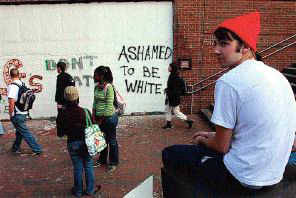
Now it’s time to relate all of this to Christianity. What is the Church supposed to do about the lingering racism that festers in our nation? One student’s response to the graffiti at NSCU offered a partial answer: when the wall had been whitewashed, he wrote, “Ashamed to be white.” Malcolm X and Carmichael both believed that whites admitting the sin of racism was the first step to the emancipation of blacks—and, as Cone would add, the emancipation of whites, for “the man who enslaves another enslaves himself.” Most churches confess corporate sin on at least a weekly basis. How do we confess the inherited sin of racism?

One answer comes from Malcolm Boyd in his book Are You Running With Me, Jesus? “During a Freedom Ride in the Deep South in 1961, one of my fellow Episcopalian priests said: ‘It seems to me this is really a kind of prayer—a kind of corporate confession of sin.’” This aligns with James H. Cone’s insistence that Christ’s very being is tied up with his identification with the oppressed peoples of the world—and that the Church must enter into a radical identification with that oppressed Christ and our neighbors with whom he shares his person.

The first step towards reconciliation is confession. The off-Broadway hit Avenue Q, although crass at times (or half the time) makes a good point in its song “Everyone’s a Little Bit Racist.” If we insist that race is not an issue, we only prop up old systems of injustice. The Church must help confront Americans with the sin of racism. And the Church must provide a model for radical identification with the oppressed. To do otherwise is to deny Christ.
Thursday, October 30, 2008

Take Advantage of Me

Every Sunday, I take the exit off the highway towards my church, and at the stoplight, there is always at least one man either panhandling or selling newspapers. I rarely have cash, so I don't often give them money or buy a paper, but the sight challenges me every time. I've talked to many people, both Christian and not, who have various rationales for whether or not they should give money to panhandlers. I think the argument that fascinates me most is that you don't want to be taken advantage of—that you want to make sure your money goes to good use.

Lately, I've been wondering if maybe we are called to be taken advantage of by others. I don't know exactly where he says this, but Dietrich Bonhoeffer, a German pastor-theologian who died in a Nazi concentration camp and is a personal hero of mine, said that this is the case. He said that we serve a God who allowed himself to be taken advantage of to the point of being crucified, and, as people living in the shadow of the cross, we should not cling to our pride so much that we fail to participate in the crucifixion by taking up our own cross.

This has come up for me a lot lately because I've gotten myself into some situations and relationships where I sometimes wonder if I should feel taken advantage of. Last summer, I taught music at a new kids' program at my church, and I formed bonds with several of the children that lasted past the summer, particularly with a few who live near me. One brother-sister combo who went to the camp live in a challenging home situation and have begun to look to me for all kinds of support. Most recently, this has meant that several times in the past few weeks I have been woken up around 7 a.m. by a phone call from my 12-year-old friend asking for a ride to school because she missed her bus. More than once, when I've dragged myself out of bed to go pick her up, one or more of her 6 siblings has also begged a ride.

Something in me starts to resent the early-morning phone calls and the gas I'm using driving these kids to school, but I can't quite feel that way. For one thing, I can see a tendency of the haves to exercise power over the have-nots, even—and especially—when the haves do something good for the have-nots. Good deeds might be done out of a selfless desire to follow Christ, but if we are frustrated when we don't see gratitude or when handouts aren't used "correctly," we have moved from serving to controlling. When we dictate the terms of our justice and charity, it becomes simply another means of maintaining the status quo and socioeconomic inequality.

I'm 21 years old and I have my own car. I attend one of the most prestigious universities in the country. My parents love me and continue to support me financially and otherwise. I can't pride myself in having these things that others don't; and, in fact, I believe that I am obligated as a Christian to share my various forms of wealth with others without micromanaging the ways in which that plays out. As long as I live in a society that makes a 12-year-old immigrant girl one of the downtrodden, I will get out of bed at 7 in the morning to drive that girl to school.

Wednesday, August 27, 2008

I Am Not What I Own (Prayer)

Dear God,
I am so afraid to open my clenched fists!
Who will I be when I have nothing left to hold on to?
Who will I be when I stand before you with my empty hands?
Please help me gradually open my hands
and to discover that I am not what I own,
but what you want to give me.
And what you want to give me is love,
unconditional, everlasting love.

— Henri Nouwen

Saturday, August 2, 2008

Jesus, Take the Wheel?

Last Thursday evening, I was driving home with four of my housemates in the car when a man in a pickup truck blew through a stop sign and slammed into me. My car wound up in someone's front yard with the hood completely smashed and one rear taillight destroyed. Despite extensive damage, no one in my car was hurt except for a few bruises, and though an unbuckled 9-year-old in the truck lost a few teeth, it could have been much worse.

Once we had all calmed down and called the police, we were able to laugh a little. As we had started our drive home that night, in the midst of confusion about which way to turn at the first intersection, one of my friends had exclaimed, "Jesus, take the wheel!" We had all half-jokingly repeated the exhortation just minutes before the wreck.

The police came, and a few of our friends with whom we had just had dinner rushed over to check on us and to help take us and the contents of my trunk back to the house. As we surveyed the damage, someone remarked, "God must have really big plans for you guys, because he saved you all tonight."

At those words, I felt like a stone had dropped into my stomach. It's not that I don't believe it. One friend who came to help said he'd never seen a wreck with damage like that—severe damage to the front and the back of the car—where the area containing the passengers had been left intact. If I had been driving a tiny bit faster, my friend in the seat next to me would be seriously injured or maybe even dead. Someone was watching out for us that night.

But I have always struggled to balance gratitude for God's power to heal and protect with the knowledge that not everyone is healed and not every car crash ends the way ours did. In trying to wrap my mind around my friend’s assertion that I am important enough to God's plan for him to save me and my friends, I can't help but ask—what about people I know who have died in similar situations? What about Molly, the college student who worked with my youth group when I was in middle school and was killed in a head-on collision? Did God not have important enough plans for her?

I don’t know that I ever want a definitive answer to these questions. I sometimes feel like in this world we are too dissatisfied with mystery. If we are to serve the God who makes himself known in bread and wine, the God who allows some people to linger a little while on Earth but welcomes those who go home before we are ready to let them go, we have to be able to accept difficult mysteries.

I wonder if the only response we have to miracles and to tragedy alike is love. Whether rejoicing at someone being plucked out of the fire (John Wesley, anyone?) or mourning with someone for whom healing did not take the form they most wanted, we are told, "Let all that you do be done in love" (1 Corinthians 16:14). Maybe understanding is not the most important thing.

Wednesday, July 30, 2008

From What I Am Not (Prayer)

My prayers, God, flow from what I am not;
I think thy answers make me what I am.
Like weary waves thought flows upon thought,
But the still depth beneath is all thine own.
And there thou movest in paths to us unknown.
Out of the strange strife thy peace is strangely wrought;
If the lion in us pray—thou answerest the lamb.
— George MacDonald

Saturday, July 19, 2008

Leaving Christ on the Street

And the least of these look like criminals to me
So I leave Christ on the street
— Caedmon's Call

Nothing that I Need

This world has nothing for me
And this world has everything
All that I could want
And nothing that I need
— Caedmon's Call

Sunday, December 21, 2008

Ashamed to Be White

I’ve known for a while that racial reconciliation was going to be a particular focus of my ministry and vocation. Lately, I’ve embraced that with full force, especially in my choices for reading material—I’ve read Stokely Carmichael’s Black Power and The Autobiography of Malcolm X, and I’m almost done with James H. Cone’s Black Theology and Black Power.

People don’t understand my interest in and stance on race issues (I’m white, by the way). They tell me that it’s the 21st century, that the 1960s were a long time ago. They tell me race isn’t as much of an issue anymore. When Obama was elected, I wanted to talk about the significance of his racial background but was told by several people that it didn’t matter that he was black. True, his ethnicity has nothing to do with how well he’ll lead the country, but I couldn’t help but notice that everyone who said this to me was white. My black friends knew it mattered that they had a black president.

You can tell me that race isn’t an issue, even that Obama’s victory ushered in a new era in race relations, but I won’t believe you. After the election, students at N.C. State wrote graffiti on a wall on campus with such hateful messages as “Hang Obama by a noose” and “Shoot that n----- in the head.” And this at a respected institution of higher learning. What were you saying about race not being an issue anymore?

Now it’s time to relate all of this to Christianity. What is the Church supposed to do about the lingering racism that festers in our nation? One student’s response to the graffiti at NSCU offered a partial answer: when the wall had been whitewashed, he wrote, “Ashamed to be white.” Malcolm X and Carmichael both believed that whites admitting the sin of racism was the first step to the emancipation of blacks—and, as Cone would add, the emancipation of whites, for “the man who enslaves another enslaves himself.” Most churches confess corporate sin on at least a weekly basis. How do we confess the inherited sin of racism?

One answer comes from Malcolm Boyd in his book Are You Running With Me, Jesus? “During a Freedom Ride in the Deep South in 1961, one of my fellow Episcopalian priests said: ‘It seems to me this is really a kind of prayer—a kind of corporate confession of sin.’” This aligns with James H. Cone’s insistence that Christ’s very being is tied up with his identification with the oppressed peoples of the world—and that the Church must enter into a radical identification with that oppressed Christ and our neighbors with whom he shares his person.

The first step towards reconciliation is confession. The off-Broadway hit Avenue Q, although crass at times (or half the time) makes a good point in its song “Everyone’s a Little Bit Racist.” If we insist that race is not an issue, we only prop up old systems of injustice. The Church must help confront Americans with the sin of racism. And the Church must provide a model for radical identification with the oppressed. To do otherwise is to deny Christ.

Thursday, October 30, 2008

Take Advantage of Me

Every Sunday, I take the exit off the highway towards my church, and at the stoplight, there is always at least one man either panhandling or selling newspapers. I rarely have cash, so I don't often give them money or buy a paper, but the sight challenges me every time. I've talked to many people, both Christian and not, who have various rationales for whether or not they should give money to panhandlers. I think the argument that fascinates me most is that you don't want to be taken advantage of—that you want to make sure your money goes to good use.

Lately, I've been wondering if maybe we are called to be taken advantage of by others. I don't know exactly where he says this, but Dietrich Bonhoeffer, a German pastor-theologian who died in a Nazi concentration camp and is a personal hero of mine, said that this is the case. He said that we serve a God who allowed himself to be taken advantage of to the point of being crucified, and, as people living in the shadow of the cross, we should not cling to our pride so much that we fail to participate in the crucifixion by taking up our own cross.

This has come up for me a lot lately because I've gotten myself into some situations and relationships where I sometimes wonder if I should feel taken advantage of. Last summer, I taught music at a new kids' program at my church, and I formed bonds with several of the children that lasted past the summer, particularly with a few who live near me. One brother-sister combo who went to the camp live in a challenging home situation and have begun to look to me for all kinds of support. Most recently, this has meant that several times in the past few weeks I have been woken up around 7 a.m. by a phone call from my 12-year-old friend asking for a ride to school because she missed her bus. More than once, when I've dragged myself out of bed to go pick her up, one or more of her 6 siblings has also begged a ride.

Something in me starts to resent the early-morning phone calls and the gas I'm using driving these kids to school, but I can't quite feel that way. For one thing, I can see a tendency of the haves to exercise power over the have-nots, even—and especially—when the haves do something good for the have-nots. Good deeds might be done out of a selfless desire to follow Christ, but if we are frustrated when we don't see gratitude or when handouts aren't used "correctly," we have moved from serving to controlling. When we dictate the terms of our justice and charity, it becomes simply another means of maintaining the status quo and socioeconomic inequality.

I'm 21 years old and I have my own car. I attend one of the most prestigious universities in the country. My parents love me and continue to support me financially and otherwise. I can't pride myself in having these things that others don't; and, in fact, I believe that I am obligated as a Christian to share my various forms of wealth with others without micromanaging the ways in which that plays out. As long as I live in a society that makes a 12-year-old immigrant girl one of the downtrodden, I will get out of bed at 7 in the morning to drive that girl to school.

Wednesday, August 27, 2008

I Am Not What I Own (Prayer)

Dear God,
I am so afraid to open my clenched fists!
Who will I be when I have nothing left to hold on to?
Who will I be when I stand before you with my empty hands?
Please help me gradually open my hands
and to discover that I am not what I own,
but what you want to give me.
And what you want to give me is love,
unconditional, everlasting love.

— Henri Nouwen

Saturday, August 2, 2008

Jesus, Take the Wheel?

Last Thursday evening, I was driving home with four of my housemates in the car when a man in a pickup truck blew through a stop sign and slammed into me. My car wound up in someone's front yard with the hood completely smashed and one rear taillight destroyed. Despite extensive damage, no one in my car was hurt except for a few bruises, and though an unbuckled 9-year-old in the truck lost a few teeth, it could have been much worse.

Once we had all calmed down and called the police, we were able to laugh a little. As we had started our drive home that night, in the midst of confusion about which way to turn at the first intersection, one of my friends had exclaimed, "Jesus, take the wheel!" We had all half-jokingly repeated the exhortation just minutes before the wreck.

The police came, and a few of our friends with whom we had just had dinner rushed over to check on us and to help take us and the contents of my trunk back to the house. As we surveyed the damage, someone remarked, "God must have really big plans for you guys, because he saved you all tonight."

At those words, I felt like a stone had dropped into my stomach. It's not that I don't believe it. One friend who came to help said he'd never seen a wreck with damage like that—severe damage to the front and the back of the car—where the area containing the passengers had been left intact. If I had been driving a tiny bit faster, my friend in the seat next to me would be seriously injured or maybe even dead. Someone was watching out for us that night.

But I have always struggled to balance gratitude for God's power to heal and protect with the knowledge that not everyone is healed and not every car crash ends the way ours did. In trying to wrap my mind around my friend’s assertion that I am important enough to God's plan for him to save me and my friends, I can't help but ask—what about people I know who have died in similar situations? What about Molly, the college student who worked with my youth group when I was in middle school and was killed in a head-on collision? Did God not have important enough plans for her?

I don’t know that I ever want a definitive answer to these questions. I sometimes feel like in this world we are too dissatisfied with mystery. If we are to serve the God who makes himself known in bread and wine, the God who allows some people to linger a little while on Earth but welcomes those who go home before we are ready to let them go, we have to be able to accept difficult mysteries.

I wonder if the only response we have to miracles and to tragedy alike is love. Whether rejoicing at someone being plucked out of the fire (John Wesley, anyone?) or mourning with someone for whom healing did not take the form they most wanted, we are told, "Let all that you do be done in love" (1 Corinthians 16:14). Maybe understanding is not the most important thing.

Wednesday, July 30, 2008

From What I Am Not (Prayer)

My prayers, God, flow from what I am not;
I think thy answers make me what I am.
Like weary waves thought flows upon thought,
But the still depth beneath is all thine own.
And there thou movest in paths to us unknown.
Out of the strange strife thy peace is strangely wrought;
If the lion in us pray—thou answerest the lamb.
— George MacDonald

Saturday, July 19, 2008

Leaving Christ on the Street

And the least of these look like criminals to me
So I leave Christ on the street
— Caedmon's Call

Nothing that I Need

This world has nothing for me
And this world has everything
All that I could want
And nothing that I need
— Caedmon's Call


Designed by Simply Fabulous Blogger Templates, Modified by Sarah Howell