This past weekend, I was at Awakening, a retreat led by Duke's Catholic Student Center. I went last semester as a first-time participant and was on staff for this retreat; for the next one, I'll be on leadership. There are some funny reflections on how a hardcore Methodist wound up in a leadership position for a Catholic retreat, but that's not what this entry is about. This past weekend, I saw the body of Christ in full force. One moment in particular was nothing short of miraculous and summed up what I think a visualization of a truly Christocentric ecclesiology might look like.
On the Awakening retreat, there are a series of talks. The topics are always the same, and they include Faith, Love, Prayer, etc. They are given by students whose lives have been changed by Awakening, and they are always incredible.
This year, a friend of mine delivered the talk on the Mystical Body of Christ (MBOC). We hadn't met long before this weekend, but we both went on the monastery trip this spring break. Naturally, both of us having a strong connection to Awakening, we talked at length about the body of Christ, the Eucharist and ecumenism while we were at the monastery. The MBOC is central to her faith, and I could tell not only in her preparation but also in the talk itself that she poured every ounce of her being into telling us what it meant to be the body of Christ.
Her talk was real, raw and challenging, but the miracle came at the end. Exhorting us to recognize Christ in each other, not in a warm-fuzzy sort of way but in a way that calls us into the suffering of our neighbor, she declared to us that we were Christ to her, and she knelt before us all. Later she told us that she was planning to kneel for about 10 seconds and then go sit down for the reflection song that is played after each talk. But that isn't what happened. She knelt for a few moments, and then there was the sound of chairs being pushed back and shoes scuffling on the floor. All of a sudden, every one of the roughly 100 people in the room was kneeling. It was not a domino effect; it wasn't as if someone thought it was a cool idea and then everyone else followed suit. Everyone just knelt. We all stayed there on our knees throughout the reflection song, "Jesus" by Page France. We knelt, smiling and crying and knowing that we could never look at each other, or anyone else, the same ever again.
I will sing a song to you
And you will shake the ground for me
And the birds and the bees and the old fruit trees
Will spit out songs like gushing streams
And Jesus will come through the ground so dirty
With worms in his hair and a hand so sturdy
To call us his magic, we call him worthy
Jesus came up through the ground so dirty
I will sing a song for you
And you will stomp your feet for me
And the bears and the bees and banana trees
Will play kazoos and tambourines
And Jesus will dance while we drink his wine
With soldiers and thieves and a sword in his side
And we will be joy and we will be right
Jesus will dance while we drink his wine
And Jesus will come through the ground so dirty
With worms in his hair and a hand so sturdy
To call us his magic, we call him worthy
Jesus came up through the ground so dirty
— "Jesus" by Page France
Monday, March 31, 2008

A Prayer from Susannah Wesley
Help me, Lord, to remember that religion is not to be confined to the church, or closet, nor exercised only in prayer and meditation, but that everywhere I am in thy presence. So may my every word and action have a moral content. May all the happenings of my life prove useful to me. May all things instruct me and afford me an opportunity of exercising some virtue and daily learning and growing toward thy likeness. Amen.
Monday, March 24, 2008
The Place of the Skull
"So they took Jesus; and carrying the cross by himself, he went out to what is called The Place of the Skull, which in Hebrew is called Golgotha." — John 19:16b-17
Golgotha is one of the few locations I remember clearly from my visit to the Holy Land as an 8-year-old. For one thing, to see the hill, you stand in a beautiful garden, which itself leaves an impression. For another, in the midst of the flowers, the rock of Golgotha really does look an awful lot like a skull (see the picture below). I recall being simultaneously repulsed by and attracted to the strangeness of the place.
Perhaps this post is a bit late, since we're into Easter now, but my dad's Good Friday sermon taught me something about Golgotha that I didn't know, something that I found fascinating and meaningful. He began by talking about the story of David and Goliath. We all know how the narrative goes, but there's a small detail that we often miss at the end: "David took the head of the Philistine and brought it to Jerusalem" (1 Samuel 17:54a). This is odd in and of itself because Jerusalem was not an Israelite city at the time. I won't get into that, since I'm not an Old Testament scholar, but there's something else at work here.
What my dad pointed out that I had never thought of is that it is no accident that the beginning of the Hebrew name for "place of the skull" is an abbreviated version of Goliath's name. Golgotha. Goliath's head had been brought to Jerusalem. Jesus was crucified at the place of the skull. Goliath's skull.
Now that revelation is enough fun as an interesting play on words, but there are a million directions you could take that. I've already got a sermon formulating in my head for whenever I may be called upon to preach on 1 Samuel 17 or John 19. When my dad drew the connection between Christ's crucifixion and young David's victory over Goliath, I immediately thought of 2 Corinthians 12:9: "My grace is sufficient for you, for power is made perfect in weakness." God turns the world's paradigms of strength and weakness on end. "God chose what is weak in the world to shame the strong" (1 Corinthians 1:27b). This theme can be seen throughout Scripture. An inarticulate Hebrew leads the Israelites out of slavery in Egypt. Barren women conceive and bear the rulers of the people (just take Sarah and Hannah as two examples, though there are plenty more). A shepherd boy fells a giant with a slingshot. A young girl is visited by an angel and told that she is to bear the Son of God. A carpenter's son from Nazareth is not simply used by God—he is God.
How wonderful, then, that at the moment of Christ's crucifixion, as he is led to Calvary, when all seems to be hopelessness and darkness, there is a subtle reminder of God's promise that what the world sees as weakness may in fact be strength beyond all imagining. Golgotha, which invoked fear in me as a child, carries in it a reminder of David's victory over Goliath—perhaps a hint of what is to come, a gentle rebuke for those of us who may see the cross and despair. It was precisely Christ's seeming weakness that allowed him to save us. God meets us in our weakness in Christ and transforms us by the power of his Holy Spirit so that we might be strengthened in him and him alone.
 Golgotha, "The Place of the Skull"
Golgotha is one of the few locations I remember clearly from my visit to the Holy Land as an 8-year-old. For one thing, to see the hill, you stand in a beautiful garden, which itself leaves an impression. For another, in the midst of the flowers, the rock of Golgotha really does look an awful lot like a skull (see the picture below). I recall being simultaneously repulsed by and attracted to the strangeness of the place.
Perhaps this post is a bit late, since we're into Easter now, but my dad's Good Friday sermon taught me something about Golgotha that I didn't know, something that I found fascinating and meaningful. He began by talking about the story of David and Goliath. We all know how the narrative goes, but there's a small detail that we often miss at the end: "David took the head of the Philistine and brought it to Jerusalem" (1 Samuel 17:54a). This is odd in and of itself because Jerusalem was not an Israelite city at the time. I won't get into that, since I'm not an Old Testament scholar, but there's something else at work here.
What my dad pointed out that I had never thought of is that it is no accident that the beginning of the Hebrew name for "place of the skull" is an abbreviated version of Goliath's name. Golgotha. Goliath's head had been brought to Jerusalem. Jesus was crucified at the place of the skull. Goliath's skull.
Now that revelation is enough fun as an interesting play on words, but there are a million directions you could take that. I've already got a sermon formulating in my head for whenever I may be called upon to preach on 1 Samuel 17 or John 19. When my dad drew the connection between Christ's crucifixion and young David's victory over Goliath, I immediately thought of 2 Corinthians 12:9: "My grace is sufficient for you, for power is made perfect in weakness." God turns the world's paradigms of strength and weakness on end. "God chose what is weak in the world to shame the strong" (1 Corinthians 1:27b). This theme can be seen throughout Scripture. An inarticulate Hebrew leads the Israelites out of slavery in Egypt. Barren women conceive and bear the rulers of the people (just take Sarah and Hannah as two examples, though there are plenty more). A shepherd boy fells a giant with a slingshot. A young girl is visited by an angel and told that she is to bear the Son of God. A carpenter's son from Nazareth is not simply used by God—he is God.
How wonderful, then, that at the moment of Christ's crucifixion, as he is led to Calvary, when all seems to be hopelessness and darkness, there is a subtle reminder of God's promise that what the world sees as weakness may in fact be strength beyond all imagining. Golgotha, which invoked fear in me as a child, carries in it a reminder of David's victory over Goliath—perhaps a hint of what is to come, a gentle rebuke for those of us who may see the cross and despair. It was precisely Christ's seeming weakness that allowed him to save us. God meets us in our weakness in Christ and transforms us by the power of his Holy Spirit so that we might be strengthened in him and him alone.
 Golgotha, "The Place of the Skull"
Sunday, March 23, 2008
Christ the Lord Is Risen Today (Hymn)
Made like him, like him we rise; Alleluia!
Ours the cross, the grave, the skies; Alleluia!
— Charles Wesley
Ours the cross, the grave, the skies; Alleluia!
— Charles Wesley
Saturday, March 22, 2008
He Descended Into Hell
In my United Methodist Church, our version of the Apostle's Creed leaves out the line "he descended into Hell." I've always lamented this (or at least wondered about, since I doubt I was too concerned about it as an 8-year-old), because the descent into Hell is fascinating, redemptive and gives meaning to Holy Saturday.
One of the best reflections I've ever had to do on the descent to hell involved studying a Russian icon of the Harrowing of Hades:
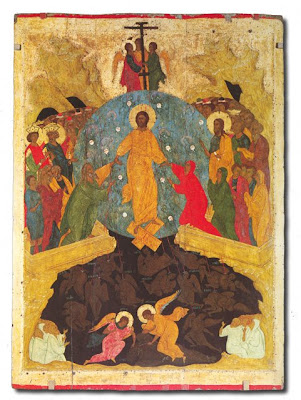 It may be hard to see at this resolution, but there are really neat aspects that can be picked out. Jesus is in the center, and he's standing on the gates of Hell, which have been broken and now form the shape of a cross. On his left and right are Adam and Eve, whom he raises from Hell, and ranked behind them are the Old Testament kings and prophets, including Abraham and Sarah, David, Samuel and so on. Below, in the depths of Hell, two angels bind Satan, whose power has been broken, with chains.
There are plenty more minute details that make this icon not only aesthetically pleasing but also illustrative and instructive of the events of Holy Saturday, but I'll spare you. I just love the thought that even in the silence of the in-between time of Holy Saturday, even on that Sabbath day, Jesus was hard at work rescuing damned souls. Perhaps this should give us a hint that in these in-between times, here and now, with the Kingdom being already-but-not-yet, Christ is striving to save our souls so that we can be raised with him in glory at the last trumpet.
One of the best reflections I've ever had to do on the descent to hell involved studying a Russian icon of the Harrowing of Hades:
 It may be hard to see at this resolution, but there are really neat aspects that can be picked out. Jesus is in the center, and he's standing on the gates of Hell, which have been broken and now form the shape of a cross. On his left and right are Adam and Eve, whom he raises from Hell, and ranked behind them are the Old Testament kings and prophets, including Abraham and Sarah, David, Samuel and so on. Below, in the depths of Hell, two angels bind Satan, whose power has been broken, with chains.
There are plenty more minute details that make this icon not only aesthetically pleasing but also illustrative and instructive of the events of Holy Saturday, but I'll spare you. I just love the thought that even in the silence of the in-between time of Holy Saturday, even on that Sabbath day, Jesus was hard at work rescuing damned souls. Perhaps this should give us a hint that in these in-between times, here and now, with the Kingdom being already-but-not-yet, Christ is striving to save our souls so that we can be raised with him in glory at the last trumpet.
The Saints Who Had Fallen Asleep
"At that moment the curtain of the temple was torn in two, from top to bottom. The earth shook, and the rocks were split. The tombs were also opened, and many bodies of the saints who had fallen asleep were raised. After his resurrection they came out of the tombs and entered the holy city and appeared to many." — Matthew 27:51-53
I have always thought that this passage was just so, so cool. The first time I heard this after having learned about the general resurrection, I was shocked. It's eschatologically problematic to have dead people walking around before the end times. I've never read a commentary on this passage, and I know that this particular part is unique to Matthew's Gospel, but what else could this possibly be than a graphic foretaste of the coming resurrection of the body? Jesus' own resurrection was in and of itself a prefiguration of the general resurrection—"for as all die in Adam, so all will be made alive in Christ" (1 Corinthians 15:22)—but, as if the point needed to be driven home further still, here we have regular people getting up out of the grave. So all will be made alive.
I have always thought that this passage was just so, so cool. The first time I heard this after having learned about the general resurrection, I was shocked. It's eschatologically problematic to have dead people walking around before the end times. I've never read a commentary on this passage, and I know that this particular part is unique to Matthew's Gospel, but what else could this possibly be than a graphic foretaste of the coming resurrection of the body? Jesus' own resurrection was in and of itself a prefiguration of the general resurrection—"for as all die in Adam, so all will be made alive in Christ" (1 Corinthians 15:22)—but, as if the point needed to be driven home further still, here we have regular people getting up out of the grave. So all will be made alive.
Friday, March 21, 2008
O Sacred Head Now Wounded (Hymn)
What language shall I borrow
To thank thee, dearest friend,
For this, thy dying sorrow,
Thy pity without end?
O make me thine forever;
And should I fainting be,
Lord let me never, never
Outlive my love for me.
— Anonymous
To thank thee, dearest friend,
For this, thy dying sorrow,
Thy pity without end?
O make me thine forever;
And should I fainting be,
Lord let me never, never
Outlive my love for me.
— Anonymous
Subscribe to:
Posts (Atom)
Monday, March 31, 2008
The Ground So Dirty
This past weekend, I was at Awakening, a retreat led by Duke's Catholic Student Center. I went last semester as a first-time participant and was on staff for this retreat; for the next one, I'll be on leadership. There are some funny reflections on how a hardcore Methodist wound up in a leadership position for a Catholic retreat, but that's not what this entry is about. This past weekend, I saw the body of Christ in full force. One moment in particular was nothing short of miraculous and summed up what I think a visualization of a truly Christocentric ecclesiology might look like.
On the Awakening retreat, there are a series of talks. The topics are always the same, and they include Faith, Love, Prayer, etc. They are given by students whose lives have been changed by Awakening, and they are always incredible.
This year, a friend of mine delivered the talk on the Mystical Body of Christ (MBOC). We hadn't met long before this weekend, but we both went on the monastery trip this spring break. Naturally, both of us having a strong connection to Awakening, we talked at length about the body of Christ, the Eucharist and ecumenism while we were at the monastery. The MBOC is central to her faith, and I could tell not only in her preparation but also in the talk itself that she poured every ounce of her being into telling us what it meant to be the body of Christ.
Her talk was real, raw and challenging, but the miracle came at the end. Exhorting us to recognize Christ in each other, not in a warm-fuzzy sort of way but in a way that calls us into the suffering of our neighbor, she declared to us that we were Christ to her, and she knelt before us all. Later she told us that she was planning to kneel for about 10 seconds and then go sit down for the reflection song that is played after each talk. But that isn't what happened. She knelt for a few moments, and then there was the sound of chairs being pushed back and shoes scuffling on the floor. All of a sudden, every one of the roughly 100 people in the room was kneeling. It was not a domino effect; it wasn't as if someone thought it was a cool idea and then everyone else followed suit. Everyone just knelt. We all stayed there on our knees throughout the reflection song, "Jesus" by Page France. We knelt, smiling and crying and knowing that we could never look at each other, or anyone else, the same ever again.
I will sing a song to you
And you will shake the ground for me
And the birds and the bees and the old fruit trees
Will spit out songs like gushing streams
And Jesus will come through the ground so dirty
With worms in his hair and a hand so sturdy
To call us his magic, we call him worthy
Jesus came up through the ground so dirty
I will sing a song for you
And you will stomp your feet for me
And the bears and the bees and banana trees
Will play kazoos and tambourines
And Jesus will dance while we drink his wine
With soldiers and thieves and a sword in his side
And we will be joy and we will be right
Jesus will dance while we drink his wine
And Jesus will come through the ground so dirty
With worms in his hair and a hand so sturdy
To call us his magic, we call him worthy
Jesus came up through the ground so dirty
— "Jesus" by Page France
A Prayer from Susannah Wesley
Help me, Lord, to remember that religion is not to be confined to the church, or closet, nor exercised only in prayer and meditation, but that everywhere I am in thy presence. So may my every word and action have a moral content. May all the happenings of my life prove useful to me. May all things instruct me and afford me an opportunity of exercising some virtue and daily learning and growing toward thy likeness. Amen.
Monday, March 24, 2008
The Place of the Skull
"So they took Jesus; and carrying the cross by himself, he went out to what is called The Place of the Skull, which in Hebrew is called Golgotha." — John 19:16b-17
Golgotha is one of the few locations I remember clearly from my visit to the Holy Land as an 8-year-old. For one thing, to see the hill, you stand in a beautiful garden, which itself leaves an impression. For another, in the midst of the flowers, the rock of Golgotha really does look an awful lot like a skull (see the picture below). I recall being simultaneously repulsed by and attracted to the strangeness of the place.
Perhaps this post is a bit late, since we're into Easter now, but my dad's Good Friday sermon taught me something about Golgotha that I didn't know, something that I found fascinating and meaningful. He began by talking about the story of David and Goliath. We all know how the narrative goes, but there's a small detail that we often miss at the end: "David took the head of the Philistine and brought it to Jerusalem" (1 Samuel 17:54a). This is odd in and of itself because Jerusalem was not an Israelite city at the time. I won't get into that, since I'm not an Old Testament scholar, but there's something else at work here.
What my dad pointed out that I had never thought of is that it is no accident that the beginning of the Hebrew name for "place of the skull" is an abbreviated version of Goliath's name. Golgotha. Goliath's head had been brought to Jerusalem. Jesus was crucified at the place of the skull. Goliath's skull.
Now that revelation is enough fun as an interesting play on words, but there are a million directions you could take that. I've already got a sermon formulating in my head for whenever I may be called upon to preach on 1 Samuel 17 or John 19. When my dad drew the connection between Christ's crucifixion and young David's victory over Goliath, I immediately thought of 2 Corinthians 12:9: "My grace is sufficient for you, for power is made perfect in weakness." God turns the world's paradigms of strength and weakness on end. "God chose what is weak in the world to shame the strong" (1 Corinthians 1:27b). This theme can be seen throughout Scripture. An inarticulate Hebrew leads the Israelites out of slavery in Egypt. Barren women conceive and bear the rulers of the people (just take Sarah and Hannah as two examples, though there are plenty more). A shepherd boy fells a giant with a slingshot. A young girl is visited by an angel and told that she is to bear the Son of God. A carpenter's son from Nazareth is not simply used by God—he is God.
How wonderful, then, that at the moment of Christ's crucifixion, as he is led to Calvary, when all seems to be hopelessness and darkness, there is a subtle reminder of God's promise that what the world sees as weakness may in fact be strength beyond all imagining. Golgotha, which invoked fear in me as a child, carries in it a reminder of David's victory over Goliath—perhaps a hint of what is to come, a gentle rebuke for those of us who may see the cross and despair. It was precisely Christ's seeming weakness that allowed him to save us. God meets us in our weakness in Christ and transforms us by the power of his Holy Spirit so that we might be strengthened in him and him alone.
Golgotha, "The Place of the Skull"Sunday, March 23, 2008
Christ the Lord Is Risen Today (Hymn)
Made like him, like him we rise; Alleluia!
Ours the cross, the grave, the skies; Alleluia!
— Charles Wesley
Saturday, March 22, 2008
He Descended Into Hell
In my United Methodist Church, our version of the Apostle's Creed leaves out the line "he descended into Hell." I've always lamented this (or at least wondered about, since I doubt I was too concerned about it as an 8-year-old), because the descent into Hell is fascinating, redemptive and gives meaning to Holy Saturday.
One of the best reflections I've ever had to do on the descent to hell involved studying a Russian icon of the Harrowing of Hades:It may be hard to see at this resolution, but there are really neat aspects that can be picked out. Jesus is in the center, and he's standing on the gates of Hell, which have been broken and now form the shape of a cross. On his left and right are Adam and Eve, whom he raises from Hell, and ranked behind them are the Old Testament kings and prophets, including Abraham and Sarah, David, Samuel and so on. Below, in the depths of Hell, two angels bind Satan, whose power has been broken, with chains.
There are plenty more minute details that make this icon not only aesthetically pleasing but also illustrative and instructive of the events of Holy Saturday, but I'll spare you. I just love the thought that even in the silence of the in-between time of Holy Saturday, even on that Sabbath day, Jesus was hard at work rescuing damned souls. Perhaps this should give us a hint that in these in-between times, here and now, with the Kingdom being already-but-not-yet, Christ is striving to save our souls so that we can be raised with him in glory at the last trumpet.
The Saints Who Had Fallen Asleep
"At that moment the curtain of the temple was torn in two, from top to bottom. The earth shook, and the rocks were split. The tombs were also opened, and many bodies of the saints who had fallen asleep were raised. After his resurrection they came out of the tombs and entered the holy city and appeared to many." — Matthew 27:51-53
I have always thought that this passage was just so, so cool. The first time I heard this after having learned about the general resurrection, I was shocked. It's eschatologically problematic to have dead people walking around before the end times. I've never read a commentary on this passage, and I know that this particular part is unique to Matthew's Gospel, but what else could this possibly be than a graphic foretaste of the coming resurrection of the body? Jesus' own resurrection was in and of itself a prefiguration of the general resurrection—"for as all die in Adam, so all will be made alive in Christ" (1 Corinthians 15:22)—but, as if the point needed to be driven home further still, here we have regular people getting up out of the grave. So all will be made alive.
Friday, March 21, 2008
O Sacred Head Now Wounded (Hymn)
What language shall I borrow
To thank thee, dearest friend,
For this, thy dying sorrow,
Thy pity without end?
O make me thine forever;
And should I fainting be,
Lord let me never, never
Outlive my love for me.
— Anonymous
Subscribe to:
Posts (Atom)
